
The GTA North Neighborhood & Luxury Living Guide you need in 2026 covers far more than a list of municipalities with vague descriptions of green space and commute times. It maps the complete spectrum of living experiences across York Region’s most coveted communities — from the transit-linked condos of the Vaughan Metropolitan Centre where one-bedroom units start near $450,000, to the gated estate lots of King City where custom-built homes command $5 million and beyond. It examines the Richmond Hill real estate trends reshaping Legacy Hill, the Markham tech corridor that draws professionals from across Canada, the quiet residential character of Aurora and Newmarket, and the emerging affordability narrative of Whitchurch-Stouffville. This guide, prepared by the relocation team at Metropolitan Movers GTA North, gives every prospective buyer, renter, and relocating family the neighbourhood-by-neighbourhood intelligence they need before committing to any GTA North address.
York Region’s nine municipalities form the economic and residential backbone of the Greater Toronto Area’s north corridor, and they are not interchangeable. Each community carries a distinct price profile, school ecosystem, transit reality, and lifestyle character. Choosing Richmond Hill over Markham — or Aurora over Newmarket — has financial consequences that compound over years. This GTA North Neighborhood & Luxury Living Guide examines every major variable so your decision is driven by data, not assumption.
Whether you are relocating from Toronto to the GTA North corridor for more space and better schools, moving within York Region between municipalities, or arriving from another province entirely, the intelligence in this resource builds the foundation for a confident, well-planned move.
York Region Real Estate Market in 2026: The Conditions Every GTA North Buyer Must Understand
Before examining individual communities, every buyer and renter navigating the GTA North corridor needs to understand the broad market conditions shaping York Region’s housing landscape in 2026.
The Buyer’s Market Signal That Changes Negotiations
York Region entered 2026 as a buyers’ market trending toward balance — a condition that gives prepared, patient buyers leverage they have not enjoyed since before the pandemic era. Average residential sale prices across the region are expected to see measured increases of approximately four percent compared to 2025 levels, while sales volume is anticipated to rise by roughly five percent as buyer confidence returns. Properties that lingered on the market for 100-plus days have begun attracting showings and offers. Conditional sales — including conditions for financing, inspection, and sale of existing property — have become substantially more common as sellers accept terms they would have rejected outright during the peak market of 2021 and 2022.
Buyers with a well-structured offer and a clear budget hold real power in 2026. The urgency that defined pandemic-era purchases does not exist in the current environment. Understanding this dynamic — and using it to negotiate rather than rush — is the most important strategic advantage any GTA North buyer can carry into this market.
Condo Entry Points Are the Most Accessible in Years
First-time buyers are entering York Region through the condo segment, and 2026 presents some of the most accessible pricing in recent memory. One-bedroom units are priced near $500,000 in Markham and Richmond Hill. Some Vaughan Metropolitan Centre condos have dipped to approximately $450,000, representing a meaningful entry point for buyers who have built savings but cannot yet access freehold housing at regional average prices. For families relocating from Richmond Hill to other Ontario destinations or moving within the region, the condo correction creates both exit and re-entry opportunities that did not exist twelve months ago.
Single-Family Homes: Where Demand Concentrates
Despite condo softness, single-detached homes are expected to see the strongest demand and sales activity across York Region in 2026 — driven by limited inventory, sustained interest from move-up buyers and families, and continued population growth from new Canadians seeking larger, long-term housing options. New construction subdivisions across Markham, Richmond Hill, Georgina, Vaughan, and East Gwillimbury have begun pre-sales after two to four years on hold, with building activity expected to accelerate through mid-2026. For families moving to Newmarket from other parts of Ontario specifically for larger home footprints and better value, the pre-construction market in 2026 offers structured deposit timelines that align with relocation planning.
Richmond Hill: Where Luxury Meets Connectivity in York Region’s Third-Largest City
Moving to Richmond Hill, Ontario: What the Community Actually Delivers
Richmond Hill is a city of 202,000 residents situated approximately 20 kilometres north of downtown Toronto. It sits between Vaughan to the west and Markham to the east, with Aurora directly north. Its geography sits at a higher elevation than most GTA communities, straddling the Oak Ridges Moraine and creating a varied landscape of kettle lakes, forested ravines, and rolling topography that defines the look and feel of its residential streets.
Richmond Hill is home to the David Dunlap Observatory — Canada’s largest telescope facility — and has evolved from a prosperous suburban town into a fully urbanized city with a diverse economic base that includes the corporate headquarters of Rogers Communications, BMW Canada, and Lexmark. Its southern corridor — particularly the Leslie Street and Highway 7 corridor — hosts the city’s industrial and commercial hub, while northern Richmond Hill preserves the heritage character of the original village.
For families seeking the combination of school quality, established neighbourhood character, green space access, and transit connectivity within York Region, Richmond Hill consistently ranks among the top communities in the GTA North corridor. All York Region communities benefit from top-ranked schools, ample parking, forested surroundings, transit hubs operated by Metrolinx, and direct freeway access to the 404 and 407 — but Richmond Hill’s density and development maturity make these advantages more immediately accessible than in newer communities to the north.
Richmond Hill Real Estate Trends 2026: What Buyers Are Paying
The Richmond Hill real estate market in early 2026 shows an average home price of approximately $1,192,000, with homes spending a median of 43 days on the market. The Legacy Hill community in northern Richmond Hill continues to be a draw for extended families seeking larger homes and a more luxurious lifestyle — with construction actively underway and 2026 closings available. Legacy Hill benefits from direct access to GO Transit and Highway 404 via Elgin Mills, making it both a premium lifestyle address and a practical commuter base.
Larger condominiums in Thornhill and Richmond Hill are also in demand, particularly as downsizers and empty nesters look to reduce maintenance obligations without leaving the community they have built their lives in. The southern Richmond Hill market — near Major Mackenzie Drive and Highway 7 — provides the most accessible price points for first-time buyers, with one-bedroom condos near $500,000 representing the current entry threshold.
For buyers moving from Markham or other York Region municipalities into Richmond Hill, the physical move itself requires planning around Richmond Hill’s newer subdivision street layouts, which often feature narrowed road widths and closely spaced homes that affect moving truck access and timeline coordination.
Vaughan and the Vaughan Metropolitan Centre: Urban Living in a Suburban Framework
Best Neighborhoods in Vaughan for Families: From Kleinburg to the VMC
Vaughan encompasses one of the most internally diverse housing landscapes in York Region. Its western communities — Kleinburg, Woodbridge, and Vellore Village — deliver traditional suburban family living with generous lot sizes, strong elementary schools, and access to the McMichael Canadian Art Collection, one of Canada’s premier public art institutions. Its eastern corridor — concentrated around the Vaughan Metropolitan Centre — delivers something fundamentally different: a rapidly urbanizing downtown with subway connectivity to Toronto, mixed-use towers, and the infrastructure profile of a genuine urban centre rather than a suburb.
With a population now exceeding 300,000 and projected to approach 500,000 by 2041, Vaughan is one of Canada’s fastest-growing cities. The City of Vaughan has committed to developing 1.5 million square feet of office space and 750,000 square feet of retail space around the VMC corridor by 2031, creating an employment base that reduces the downtown Toronto commute dependency that defines most of York Region’s working population.
Families choosing Vaughan benefit from a deliberate range of neighbourhood types. Those who prioritize quiet residential streets, strong French-language school options, and the Humber River trail system gravitate toward Kleinburg and Woodbridge. Those who prioritize transit, urban amenities, and investment appreciation gravitate toward the VMC corridor, where the Line 1 subway terminus connects commuters to York University in approximately 7 minutes and Bay Street in approximately 45 minutes. For senior family members relocating to Vaughan alongside younger household members, the VMC’s walkable urban design offers accessibility advantages that Vaughan’s car-dependent western suburbs do not match.
Vaughan Metropolitan Centre Condo Living: The Numbers Behind the Urban Vision
The VMC is Vaughan’s new downtown — a 125-acre commercial development located east of Highway 400 and Highway 7, with the TTC subway station at its core. Designed to house more than 25,000 people and provide 11,500 local jobs, the VMC is the largest and most ambitious development project in Vaughan’s history.
The typical resale price for homes including condominiums in Vaughan sits near $1,293,000. Condo investors focusing on the VMC specifically see pre-construction pricing at approximately $1,209 per square foot — with a ten-year average annual pre-construction appreciation rate of approximately eight percent. The typical rental price in Vaughan is approximately $2,675 per month, with an annual rental appreciation rate of 4.5 percent over the past decade. The condo vacancy rate sits near 2.4 percent, indicating sustained rental demand despite increased condo inventory across the GTA.
For residents moving from Toronto into Vaughan’s VMC corridor as part of a lifestyle or budget repositioning, the subway connection eliminates the commute penalty that historically defined York Region living for downtown workers.
Markham: Silicon Valley North Meets Heritage Streetscapes
Cost of Living in Markham vs Toronto: Where the Numbers Land
Markham is the largest city in York Region by population — 338,503 residents as of the 2021 census — and the only York Region municipality to earn the “Silicon Valley North” designation for its concentration of more than 1,500 technology companies. AMD, Apple, IBM, Motorola, and Oracle all maintain significant Canadian operations in Markham’s Highway 7 technology corridor, creating a professional workforce base that distinguishes the city’s housing demand profile from other GTA North communities.
The cost-of-living comparison between Markham and Toronto reveals a meaningful financial advantage for those who relocate north. To maintain the same standard of living that $7,600 per month provides in Markham, a Toronto household needs approximately $8,636 — a monthly differential of over $1,000. On an annual basis, this represents savings exceeding $12,000 for comparable lifestyle quality. The housing component drives this gap: one-bedroom condos in Markham average near $500,000 versus significantly higher equivalents in Toronto’s inner districts.
Downtown Markham, centred around the York University Markham campus area, is actively developing as an urban core. New construction of single-family homes in the Union Glen and Cornell Rouge areas of Unionville represents the most desirable new supply in the city. Unionville’s heritage Main Street — with 19th-century architecture, seasonal festivals, and the Angus Glen Golf Club — preserves a character that pure suburban communities in the corridor cannot replicate.
For families moving long distance from Markham to Ontario destinations as they reposition their lives, the decision to leave one of York Region’s strongest job markets requires careful financial modelling. But for those arriving into Markham from outside the GTA, the combination of tech employment, heritage neighbourhood character, and the most culturally diverse population in York Region makes it one of the most immediately liveable destinations in the corridor. Families arriving with specialty items — particularly pianos or large musical instruments that require specialized transport — should account for Markham’s newer subdivision layouts when planning move logistics, as some crescents and courts have limited turning radius for large moving vehicles.
Aurora: The Balanced Community That Earns Long-Term Loyalty
Aurora, ON Neighbourhood Guide: What Makes It Different from Its Neighbours
Aurora occupies a 50-square-kilometre area bordered by Newmarket to the north, Richmond Hill to the south, King to the west, and Whitchurch-Stouffville to the east. It is one of the smallest municipalities in York Region by land area but consistently ranks among the highest for quality of life metrics — combining the services and cultural programming of a fully mature community with the residential character of a small Ontario town.
Historic downtown Aurora on Yonge Street preserves century-old architecture, independent retailers, and community events that anchor residents’ sense of place in a way that newer subdivisions simply cannot replicate. The Aurora Public Library, Wellington Street amenities, and the Aurora Cultural Centre provide civic infrastructure well above what Aurora’s population size would typically support. The Aurora GO station on the Barrie rail corridor connects commuters directly to Union Station in approximately 45 minutes, providing reliable downtown access without Highway 400 or 404 dependency.
Aurora’s housing market reflects its position as a premium mid-range community. Detached homes average in the $1.1 million to $1.5 million range, with new construction in northern Aurora’s developing subdivisions available from the high $800,000s. With prices easing across York Region, Aurora has brought back buyers who were previously priced out of the market — buyers who might otherwise have looked to Simcoe or Durham regions for comparable value. For those considering a move from Aurora to other Ontario destinations, timing matters: Aurora’s improved buyer conditions in 2026 may represent the right window to execute a strategic sale.
Families relocating to Aurora specifically for its school profile benefit from some of York Region’s most consistent academic performers at both the elementary and secondary levels. Dr. G.W. Williams Secondary School has a long history of strong academic and arts programming, while Magna International’s longstanding presence in the community supports a technical and trades-oriented educational pathway through Aurora’s high school system.
For families who need packing and moving services in Aurora coordinated with school enrollment timing, building in a two-to-four-week buffer between possession date and the first day of classes allows children to settle, explore the neighbourhood, and establish routines before the academic pressure of a new school begins.
Newmarket: York Region’s Most Practical Town for Families on a Strategic Budget
Newmarket School Rankings and Relocation: What the Data Tells Growing Families
Newmarket sits at the northern edge of York Region’s developed urban corridor, bordered by East Gwillimbury to the north and Aurora to the south. It is the most functionally complete small city in the GTA North corridor — with a full complement of retail, healthcare, recreation, and cultural infrastructure — while maintaining housing prices that run meaningfully below Markham, Vaughan, and Richmond Hill.
Newmarket’s school ecosystem reflects the community’s strong family orientation. École secondaire catholique Renaissance and Huron Heights Secondary School serve the secondary population, while Upper Canada Mall area schools and the Main Street Newmarket historic district anchor an accessible urban environment with walkable amenities that purely suburban communities lack. York Region public schools consistently rank above the Ontario provincial average on EQAO assessments, and Newmarket’s schools participate in that regional advantage.
The Newmarket GO station on the Barrie rail corridor connects commuters to Union Station in approximately 55 to 65 minutes — longer than Aurora, but still practical for five-days-per-week commuters. York Region Transit’s Viva express bus network provides secondary connections across the region for residents who do not work downtown but commute within York Region.
Detached home prices in Newmarket average near $1 million to $1.2 million for established residential areas, with newer construction in East Newmarket neighbourhoods providing options from the mid-$800,000s. The combination of relative affordability within York Region, strong schools, and complete urban amenities makes Newmarket the most strategically practical choice for dual-income families who want the GTA North lifestyle without the Richmond Hill or Vaughan premium.
For families relocating their home and office simultaneously to Newmarket, the town’s established commercial corridors — particularly along Yonge Street, Davis Drive, and Leslie Street — provide immediate business infrastructure, reducing the setup period after an entrepreneurial relocation. If you are specifically moving your household goods to Newmarket from another Ontario community, planning your truck route around Newmarket’s Historic Main Street area is important — narrow heritage streetscapes and parking restrictions affect large vehicle access.
Luxury Homes in King City, Ontario: Where the GTA’s Ultra-High Net Worth Buyers Live
King City and the Exclusive Enclaves That Define GTA North Luxury
King Township — encompassing King City, Nobleton, Schomberg, and the hamlet of Kleinburg adjacent to Vaughan’s western boundary — represents the apex of the GTA North luxury residential market. The Township of King consciously limits development density, preserving a rural-estate character that no other York Region municipality offers. Lots measured in acres rather than square feet. Private gated communities with custom-built homes from established architectural firms. Equestrian properties, hobby farms, and conservation-area-adjacent estates that attract executives, entrepreneurs, and generational wealth buyers who want physical separation from the suburban density characterizing the rest of York Region.
Luxury homes in King City typically range from $2 million at the accessible end of the estate market to $8 million and beyond for premium properties on the best lots. The exclusivity of King Township’s residential market is preserved by intentional policy — the municipality maintains some of Ontario’s strictest agricultural land preservation rules, limiting subdivision development and ensuring that the estate character of existing properties is not diluted by mass housing construction.
King City proper anchors the township’s most developed residential cluster. The King GO station on the Barrie line provides rail access to Union Station for the community’s commuting residents. However, car ownership is not optional in King — the township’s geography and density patterns make driving the primary mode of transportation for virtually all daily activities. For buyers relocating to King City from more urban GTA addresses, this transition from multi-modal transit access to car dependency is a quality-of-life variable that deserves deliberate consideration.
For households moving specialty items into King City estate homes — including concert-grade pianos, large antique furniture collections, and high-value art — the long private driveways and generous ground-floor entry dimensions of estate properties actually simplify access compared to the elevator and loading dock logistics of urban condos. The physical move is typically straightforward; the planning around long-haul truck access from Highway 400 via King Road requires route confirmation before moving day. Families downsizing from King City estate homes into York Region’s smaller communities face the opposite logistical challenge: determining what a smaller home can accommodate before packing begins.
Affordable Housing in Whitchurch-Stouffville: Where GTA North Value Meets Small-Town Character
What Stouffville Delivers That Its Neighbours Cannot
Whitchurch-Stouffville occupies the southeastern corner of York Region, approximately 50 kilometres north of downtown Toronto and 55 kilometres northeast of Pearson International Airport. With a 2021 population of approximately 49,864, it remains one of the smallest municipalities in York Region — but its housing market, school access, and community character have established it as one of the most genuinely attractive alternatives for buyers priced out of Markham, Richmond Hill, or Aurora.
The average home price in Whitchurch-Stouffville in February 2026 was approximately $1,353,000, with a median of $1,114,000. Row townhouses showed the strongest transaction momentum — with 6 sales at 102 percent of asking price and an average of just 23 days on market — signalling healthy demand for properly priced townhome product even within the broader buyer’s market conditions across York Region. Stouffville has new single-family projects set to be completed by the end of 2026, adding supply to a market that has historically been constrained by the municipality’s limited development footprint.
The Stouffville GO station on the Union-Pearson line connects the community to Union Station, making Stouffville townhomes particularly attractive to investors who understand the relationship between GO rail accessibility, school catchment quality, and achievable rental rates. For buyers seeking better rent-to-price ratios than comparable product in Markham or Aurora, Stouffville’s current pricing presents a compelling case.
York Region itself has acknowledged the affordability challenge in Whitchurch-Stouffville. York Regional Council declared a housing affordability crisis in 2021, and Housing York Inc. — the region’s housing corporation — is constructing a new six-storey, 97-unit rental building at 5676 Main Street in Stouffville to address the gap. Eligible households can access information about subsidized housing in York Region through York Region’s official community housing portal, which administers the waitlist process and eligibility criteria for the region’s affordable housing programs.
For families arriving from Stouffville en route to Toronto or other GTA communities, the transition typically involves a scale increase in housing cost but a reduction in commute time — a trade-off that requires careful budget modelling before committing to a lease or purchase.
York Region Property Tax Rates: What Every GTA North Homeowner Pays in 2026
Property taxes across York Region’s nine municipalities follow a consistent framework: the total annual bill combines the regional tax rate (set by York Region), the local municipal rate (set by each city or town), and the provincial education levy. York Region imposes annual property tax on all properties across all nine municipalities, with the amount collected depending on assessed value and property type.
The regional portion of the property tax is identical across all York Region communities because it funds region-wide services — including York Region Transit, public health, regional roads, and housing programs. The local municipal portion varies by municipality and determines much of the difference in tax bills between communities. The education levy is set provincially and is uniform across Ontario.
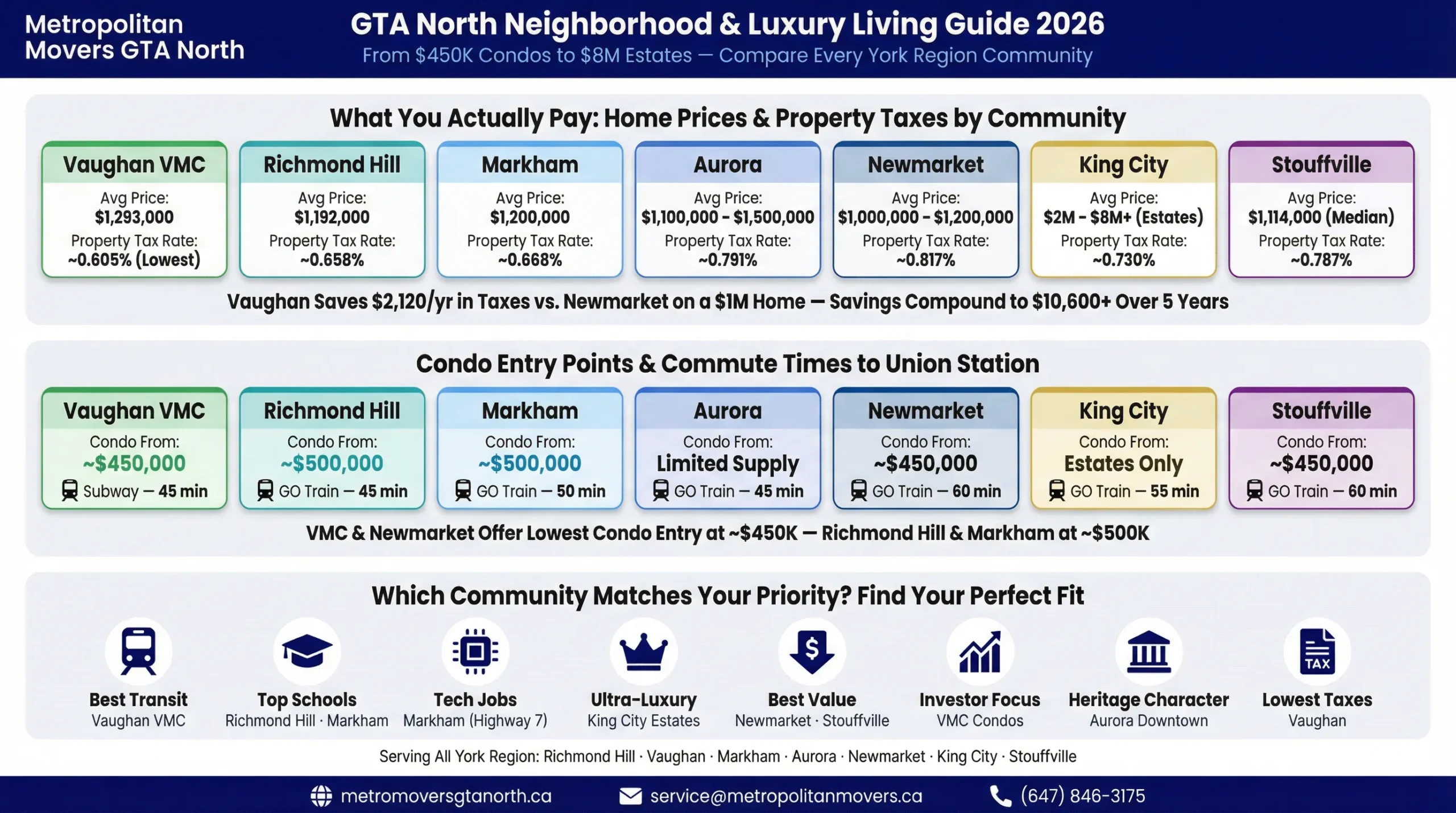
Here is how the combined residential tax rates compare across GTA North communities in 2026:
| Municipality | Approx. Combined Tax Rate | Tax on $1M Assessed Value | Relative Position |
|---|---|---|---|
| Vaughan | ~0.605% | ~$6,050/yr | Lowest in York Region |
| Richmond Hill | ~0.658% | ~$6,580/yr | Below average |
| Markham | ~0.668% | ~$6,680/yr | Near average |
| Aurora | ~0.791% | ~$7,910/yr | Above average |
| Newmarket | ~0.817% | ~$8,170/yr | Above average |
| King Township | ~0.730% | ~$7,300/yr | Mid-range |
| Whitchurch-Stouffville | ~0.787% | ~$7,870/yr | Above average |
Vaughan’s position as York Region’s lowest property tax municipality carries real dollar significance at GTA North price points. A homeowner in Vaughan with an assessed value of $1 million pays approximately $1,550 less per year than an equivalent homeowner in Newmarket — a difference that compounds over five years into more than $7,700 in cumulative tax savings. York Region also offers property tax relief programs for eligible seniors in Richmond Hill, Vaughan, and Newmarket, administered through the municipal offices. Ontario’s Senior Homeowners’ Property Tax Grant provides an additional annual credit of up to $500 for qualifying low-to-moderate income senior homeowners, administered through the province. Full details are available through Ontario.ca’s property tax programs page.
For seniors relocating from Markham or Thornhill to smaller senior-oriented communities within York Region, the property tax differential between municipalities is a legitimate factor in total cost-of-ownership calculations — particularly when seniors transition from large detached homes to townhomes or condos in a different municipality.
Comparing GTA North Communities: The Full Cost Picture Side by Side
The GTA North Neighborhood & Luxury Living Guide is only complete when every community is compared on the same terms. The table below synthesizes housing costs, property taxes, and commute profiles into a single reference framework.
| Community | Avg Home Price | Condo Entry Point | Approx. Tax Rate | Transit to Union | Best For |
|---|---|---|---|---|---|
| Richmond Hill | ~$1,192,000 | ~$500,000 | ~0.658% | GO train, ~45 min | Luxury buyers, schools |
| Vaughan (VMC) | ~$1,293,000 | ~$450,000 | ~0.605% | TTC subway, ~45 min | Transit commuters, investors |
| Markham | ~$1,200,000+ | ~$500,000 | ~0.668% | GO train, ~50 min | Tech workers, diversity |
| Aurora | ~$1,100,000 – $1,500,000 | N/A (limited) | ~0.791% | GO train, ~45 min | Families, heritage lovers |
| Newmarket | ~$1,000,000 – $1,200,000 | ~$450,000 | ~0.817% | GO train, ~60 min | Families, budget-conscious |
| King City | $2,000,000 – $8,000,000+ | N/A (freehold only) | ~0.730% | GO train, ~55 min | Ultra-luxury, estate buyers |
| Whitchurch-Stouffville | ~$1,114,000 (median) | ~$450,000 | ~0.787% | GO train, ~60 min | Small-town families, investors |
How GTA North Communities Rank by Lifestyle Priority
The GTA North Neighborhood & Luxury Living Guide is not useful unless it translates data into decisions. Here is the clearest framework for matching your household’s priorities to the right community:
Transit-dependent downtown commuters: Vaughan Metropolitan Centre or Richmond Hill — subway to Bay Street in 45 minutes from VMC; GO rail to Union in 45 minutes from Richmond Hill’s Langstaff station area.
Families optimizing for school quality and neighbourhood stability: Richmond Hill’s Legacy Hill and established older communities; Markham’s Unionville district; Aurora’s downtown core and established residential areas.
Technology industry professionals: Markham — the concentration of tech employers in the Highway 7 corridor reduces commute costs and time for anyone working within the sector.
Ultra-luxury and estate lifestyle buyers: King City and Kleinburg — no other GTA North community matches the lot sizes, privacy, and architectural ambition available in King Township.
Budget-conscious families seeking maximum space per dollar within York Region: Newmarket or Whitchurch-Stouffville — both deliver GO rail access, strong schools, and complete urban amenities at price points running $100,000 to $300,000 below the Richmond Hill and Markham averages.
Investor buyers seeking rental demand and appreciation: Vaughan VMC condos — 2.4 percent vacancy rate, strong rental appreciation history, subway connectivity, and a development pipeline that continues to add employment within walking distance.
Families managing a multigenerational relocation within York Region: Any community with established senior services — Aurora, Newmarket, and Richmond Hill all have dedicated senior property tax relief programs administered at the municipal level.
What a GTA North Move Actually Requires: Logistics by Community Type
Every community in this GTA North Neighborhood & Luxury Living Guide presents a different physical moving challenge, and understanding the logistics in advance prevents delays, cost overruns, and damage.
Vaughan Metropolitan Centre High-Rise Moves
VMC condo moves share the same building logistics as downtown Toronto towers — elevator bookings, loading dock scheduling, certificate of insurance requirements, and move-in window restrictions typically capped at four hours. The difference is that VMC buildings are newer and purpose-built, meaning loading docks are more functional and freight elevators are typically larger than in older Toronto towers. However, Highway 400 and Highway 7 interchange access must be factored into truck routing, as peak-hour congestion can significantly extend arrival times. For storage solutions during a VMC condo move — whether a staggered closing or temporary overflow — having a nearby facility managed by your moving team keeps both logistics under a single point of coordination.
Suburban Family Home Moves Across Richmond Hill, Markham, and Aurora
Newer subdivision moves in Richmond Hill, Markham, and Aurora often involve crescents and court addresses with tight turning radiuses for 53-foot trailers. Narrowed boulevard widths, municipal by-law restrictions on overnight truck parking, and close home spacing all require route pre-assessment before moving day. For families moving heavy appliances into newly constructed GTA North homes, coordinating delivery timing with your builder’s occupancy schedule prevents conflicts on possession day. Walk-in closets with narrow door frames, large kitchen islands, and second-floor laundry rooms are common features of modern GTA North builds that affect furniture positioning during the move-in process.
King City and Kleinburg Estate Moves
Estate moves in King City and Kleinburg involve long private driveways, circular front approaches, and grand-scale entryways that allow large items to be brought through principal entry points rather than stairwells. The complexity here is not access — it is volume and fragility. Estate households typically contain high-value art collections, library systems, wine storage, home theatre equipment, and multi-piece custom furniture that requires individual assessment before packing begins. Full-service packing and unpacking for an estate home is not a luxury add-on — it is a risk management necessity for belongings whose replacement cost often exceeds the moving service cost by an order of magnitude.
Last-Minute and Same-Day Moving Across York Region
York Region’s fast-changing possession timelines — particularly with conditional sales becoming more common in 2026 — create situations where buyers and sellers need last-minute moving services that can execute on compressed notice. Deals that extend beyond the initial 30 to 45-day period, as is common in 2026’s conditional sales environment, can shift closing dates with little advance warning. Having a moving partner with same-day moving capacity and established York Region routes eliminates the stress of managing a sudden timeline change without support.
For manpower-intensive moves involving large volumes or heavy items across GTA North communities — whether clearing an estate, relocating a home library, or managing the physical demands of an oversized furniture collection — having dedicated moving labour coordinated by an experienced York Region team prevents both injury risk and timeline blowout.
Metropolitan Movers GTA North brings over 15 years of York Region moving experience to every relocation across Richmond Hill, Vaughan, Markham, Aurora, Newmarket, King City, and Whitchurch-Stouffville. We understand that a King City estate move requires fundamentally different planning than a VMC condo transition — and that both require fundamentally different expertise than a Newmarket subdivision family home. Every quote reflects your specific community, building type, and household profile.
Moving Between GTA North Communities and Beyond: The Long-Distance Dimension
The GTA North Neighborhood & Luxury Living Guide also addresses the reality that not every relocation stays within York Region. Many GTA North households use 2026’s buyer-friendly conditions to make strategic long-distance moves — either departing for more affordable Ontario communities or arriving from other provinces.
For those moving from Newmarket to Belleville or from Richmond Hill to Windsor, dedicated long-distance moving services with scheduled delivery windows prevent the logistical fragmentation that self-managed provincial moves typically create. For moves from North York to Ottawa or from Markham to London, Ontario, a single moving partner who manages both origin and destination eliminates the coordination complexity of using separate movers at each end.
If you need furniture removed from your current GTA North home before a long-distance move — or freight shipped ahead of your household goods to a new destination — coordinating these services through a single provider keeps timelines aligned and accountability clear.
The Community That Fits Your Life: Making the Final Decision With Clarity
The GTA North corridor offers something no single Toronto neighbourhood can match: a genuine spectrum of living experiences that accommodates every income level, lifestyle preference, and family structure within a geographically cohesive region connected by GO Transit and York Region Transit.
The buyer priced out of Richmond Hill’s Legacy Hill community finds the same lifestyle ambitions achievable in Aurora’s newer northern subdivisions at a $200,000 to $300,000 discount. The professional who cannot justify Toronto rent finds the Vaughan Metropolitan Centre’s subway-connected condos provide the urban lifestyle at 65 percent of the downtown cost. The family who discovered they need school quality above all else finds Markham’s Unionville and Richmond Hill’s established neighbourhoods consistently deliver above-average academic outcomes. And the senior couple leaving Toronto’s condo market for the first time finds Aurora and Newmarket’s complete urban infrastructure makes the transition feel like an upgrade rather than a compromise.
This GTA North Neighborhood & Luxury Living Guide has mapped every community so that the decision you make is built on the complete picture — housing costs, property taxes, transit access, school quality, luxury segment pricing, and the physical logistics of making the move happen. And when you are ready to execute that move, Metropolitan Movers GTA North is here with over 15 years of experience across every York Region community, transparent pricing built around your specific situation, and the neighbourhood knowledge that turns a stressful relocation into a smooth beginning.
Get your customized GTA North moving estimate today and take the next step toward the community that fits your life.
Frequently Asked Questions About the GTA North Neighborhood & Luxury Living Guide
Which GTA North community has the lowest property taxes in 2026?
Vaughan carries the lowest combined residential property tax rate in York Region at approximately 0.605 percent of assessed value. A homeowner with a $1 million MPAC assessment pays approximately $6,050 annually in Vaughan, compared to approximately $8,170 in Newmarket — a difference of roughly $2,120 per year. This advantage compounds meaningfully over a five-year ownership horizon and is a factor that frequently surprises buyers who focus only on purchase price when comparing communities.
What is the average home price in Richmond Hill in 2026?
Richmond Hill’s average home price sits at approximately $1,192,000 in early 2026, with homes spending a median of 43 days on market. The Legacy Hill community in northern Richmond Hill — which targets extended families seeking luxury and larger footprints — has new construction with 2026 closings available and benefits from direct access to GO Transit and Highway 404 via Elgin Mills. One-bedroom condos in Richmond Hill provide an entry point near $500,000 for first-time buyers.
Is the Vaughan Metropolitan Centre a good place to live?
The VMC is Vaughan’s new downtown — a 125-acre urban centre anchored by a TTC Line 1 subway station, with over 20,000 daily commuters using the transit hub. Residents can reach York University in approximately 7 minutes and Bay Street in approximately 45 minutes by subway. The VMC is designed to house more than 25,000 people and generate 11,500 local jobs. Condo entry points near $450,000 make it the most transit-accessible and accessible-priced destination in York Region for first-time buyers and investors. The trade-off is that the community is still developing its retail, dining, and cultural amenities — residents accept a work-in-progress urban environment in exchange for current price advantages.
How does the cost of living in Markham compare to Toronto?
To maintain the same standard of living achievable for $7,600 per month in Markham, a Toronto household needs approximately $8,636 — a monthly differential exceeding $1,000. The primary driver is housing: one-bedroom condos in Markham average near $500,000 versus significantly higher equivalents in Toronto’s inner districts. Groceries, utilities, and most daily expenses are broadly comparable between the two cities. Car ownership costs are typically higher in Markham due to greater dependence on personal vehicles for non-commute trips.
What are luxury homes in King City actually priced at?
Luxury homes in King City range from approximately $2 million at the accessible end of the estate market to $8 million and beyond for premium properties. King Township’s development policies deliberately limit subdivision activity, preserving the rural-estate character that defines its residential market. Estate lots measured in acres, custom architectural builds, equestrian properties, and conservation-area-adjacent parcels are the defining housing types. No condominium development exists in King City — the market is exclusively freehold.
Are Newmarket schools well-ranked within York Region?
York Region public schools consistently perform above the Ontario provincial average on EQAO standardized assessments, and Newmarket’s schools participate in this regional advantage. École secondaire catholique Renaissance and Huron Heights Secondary School serve the secondary population, while the community’s elementary schools benefit from York Region’s investment in French Immersion, gifted programming, and arts-specialized streams. Families relocating to Newmarket specifically for school access should confirm their street’s catchment boundary before purchasing or leasing, as boundaries are fixed by the school board and determine eligibility.
Is Whitchurch-Stouffville affordable compared to other York Region communities?
Whitchurch-Stouffville’s median home price of approximately $1,114,000 places it below the Richmond Hill and Markham averages — making it one of the more accessible freehold communities in York Region for families with a budget ceiling in the $1 million to $1.3 million range. Townhomes in Stouffville showed the strongest transaction momentum in early 2026, with sales at 102 percent of asking price and 23-day average days-on-market — indicating that well-priced product moves quickly despite the broader buyer’s market. New single-family construction is also adding supply through late 2026.
What transit options connect GTA North communities to downtown Toronto?
GO Transit’s Barrie, Stouffville, and Richmond Hill rail lines connect Aurora, Newmarket, King City, Whitchurch-Stouffville, and Richmond Hill to Union Station. The Vaughan Metropolitan Centre provides direct TTC Line 1 subway access, reaching Union in approximately 45 minutes. York Region Transit’s Viva express bus network connects communities within the region to GO stations and TTC terminals. Markham is served by GO Bus and regional transit connections. Transit travel times to Union Station range from approximately 40 minutes (VMC subway) to 65 minutes (Newmarket GO), making all major GTA North communities practical for downtown commuters willing to use rail-based transit.
When is the best time to buy in GTA North in 2026?
York Region entered 2026 as a buyers’ market trending toward balance. Properties are sitting longer on the market, sellers are accepting conditions that were non-standard during peak years, and some segments — particularly condos — have experienced meaningful price corrections. Buyers with financing pre-approval, a clear community target, and patience to wait for the right property hold leverage that has not existed in the GTA North market since before the pandemic. The second half of 2026 may see increased activity and competition as buyer confidence returns — making the first half of the year the more strategic entry window for buyers who are ready.
How do York Region property taxes compare to Toronto?
York Region’s residential property tax rates generally run lower than Toronto’s combined residential rate — a meaningful advantage given that York Region home prices in some communities approach Toronto levels. Toronto’s combined residential rate for 2026 is approximately 0.67 percent, comparable to or slightly higher than most York Region municipalities. However, York Region homeowners typically pay on MPAC-assessed values that more closely reflect current market values than Toronto’s 2016-based assessments — a distinction that affects the actual tax bill at current market prices.