
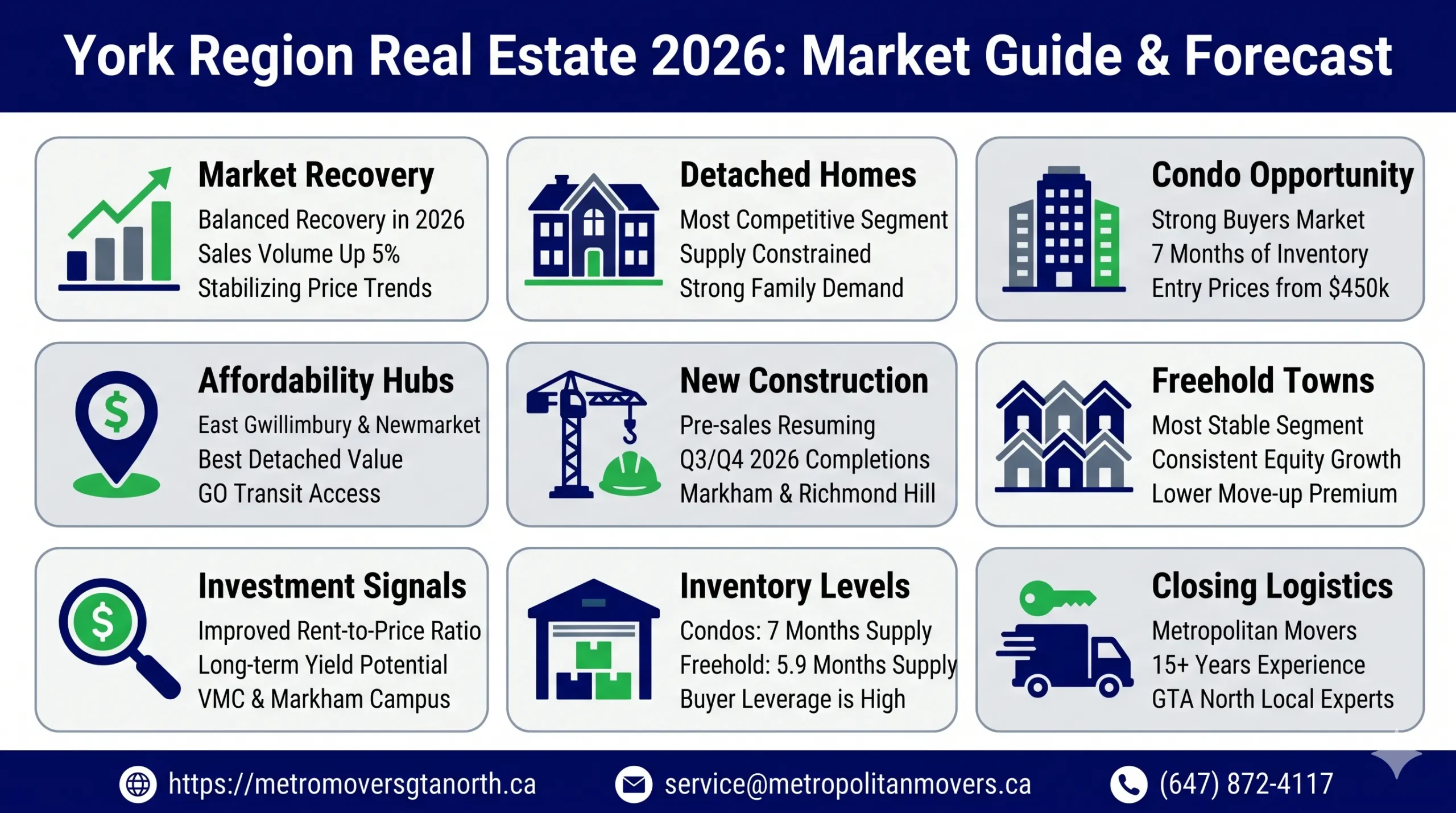
York Region real estate in 2026 operates in a fundamentally different environment than the frenzied market of 2021 and 2022. Buyers hold more leverage than they have in years. Inventory has climbed across condo and rental segments. Single-detached homes remain constrained in supply while drawing the strongest demand from families and move-up buyers. Average residential sale prices are expected to increase by approximately four percent compared to 2025, and sales volume is projected to rise by five percent — signals of a market recovering its momentum without returning to unsustainable pricing acceleration.
This guide covers every dimension of the York Region real estate landscape in 2026: property type performance, community-by-community analysis, condo market dynamics, investment signals, housing inventory conditions, and the practical relocation considerations that follow a purchase decision. Whether you are a first-time buyer, a move-up family, or an investor timing a GTA North acquisition, this resource provides the complete picture.
Before diving into market data, if you are comparing York Region communities as living destinations — schools, parks, lifestyle infrastructure, and neighbourhood character — the GTA North Neighbourhood Luxury Living Guide delivers the full side-by-side breakdown across Markham, Richmond Hill, Vaughan, Aurora, and Newmarket.
The 2026 Market Shift: From Buyer Correction to Balanced Recovery
York Region real estate entered 2026 in a buyers’ market condition trending toward balance. The correction that began in 2022 — triggered by Bank of Canada rate increases and eroding affordability — compressed sales volume and pushed prices meaningfully below peak levels across most property categories. That correction phase is now transitioning.
January 2026 data shows the freehold market with months of inventory sitting at approximately 5.96 — elevated by historical standards but declining from the deeper correction months of 2023 and 2024. Average freehold prices declined approximately 8.6 percent year-over-year in January, but the trajectory matters as much as the current reading: well-priced properties are now attracting showings and offers in compressed timeframes, and cautiously priced homes that previously sat for months are finally clearing.
The condo segment tells a slightly different story. York Region condos carry approximately seven months of inventory in early 2026 — the weakest segment of the market, with prices declining year-over-year and pricing power firmly with buyers. One-bedroom condo units in Markham and Richmond Hill trade around $500,000, while some Vaughan condos have dropped to approximately $450,000. For first-time buyers focused on minimizing upfront purchase price, York Region condos in 2026 offer the most accessible entry point the market has provided since 2020.
The rental market mirrors condo market dynamics — inventory has risen, leasing timelines have extended, and a growing share of leases are being signed below asking price, reflecting a shift toward greater tenant leverage compared to the rental conditions of 2022 and 2023.
Single-Detached Home Demand: Why Freehold Remains the Most Competitive Segment
Despite the broader market moderation, single-detached homes in York Region retain their position as the most contested property category in 2026. Limited inventory, sustained interest from move-up buyers and established families, and continued population growth from new Canadians seeking larger long-term housing options combine to keep demand structurally above supply in this category.
New single-family home construction that was paused or deferred for two to four years has now entered pre-sales across multiple York Region communities. Building activity is expected to accelerate from mid-2026, with completions projected for late Q3 and Q4 of this year. These new supply additions span Markham, Richmond Hill, Vaughan, East Gwillimbury, Stouffville, and Georgina — distributed across the region’s northern and eastern growth corridors.
Freehold townhomes occupy a strategically important position in the 2026 York Region real estate landscape. Historically, freehold townhomes have demonstrated the most consistent price performance across market cycles in York Region — less volatile than detached homes and more resilient than condos during corrections. For buyers prioritizing long-term equity growth with reduced entry price, a freehold townhome in 2026 represents the strongest risk-adjusted position in the current market.
The premium between detached homes and freehold townhomes or semi-detached properties currently sits slightly below historical averages — narrowing the move-up cost for buyers currently in freehold townhomes or semis who have been waiting for the right moment to upgrade.
York Region Real Estate by Community: Where the 2026 Opportunities Sit
York Region real estate is not a monolithic market. Conditions, price levels, inventory depth, and buyer demand vary significantly across the region’s nine municipalities. Understanding where each community sits in the 2026 cycle changes how buyers, sellers, and investors approach their decisions.
Markham: New Construction, University Corridor, and Condo Entry Points
Markham leads York Region in new construction activity in 2026. The Unionville area — specifically the Union Glen and Cornell Rouge communities — carries active new single-family home development with 2026 closing timelines available for buyers who move quickly. These projects have been in planning and infrastructure phases for years; their completion marks a meaningful addition to Markham’s freehold supply in premium neighbourhoods.
The Downtown Markham corridor surrounding York University’s Markham campus creates a specific condo opportunity in 2026. First-time buyers benefit from condo pricing in this area supported by student and young professional rental demand from the university community — a demand floor that provides income potential for investors simultaneously.
For families comparing Markham’s lifestyle infrastructure alongside its real estate opportunity, the Markham moving service page covers the city’s residential geography and operational moving considerations in detail.
Richmond Hill: Legacy Hill and the Extended-Family Market
Richmond Hill’s Legacy Hill community continues attracting extended families seeking larger detached homes in a premium lifestyle setting. Construction remains active with quick 2026 closing availability for buyers entering now. Legacy Hill properties carry architectural scale and lot sizes that attract multigenerational households — a buyer profile that consistently drives sustained demand in Richmond Hill’s upper price tiers.
Richmond Hill’s overall market follows the broader York Region pattern: condo inventory remains elevated with pricing favoring buyers, while premium freehold properties in established neighbourhoods like Oak Ridges, Jefferson Forest, and Bayview Hill maintain competitive conditions due to limited resale supply.
Buyers relocating to Richmond Hill from other Ontario cities can explore the Richmond Hill moving service to understand the practical logistics of arriving in York Region’s second-largest municipality.
Aurora: Established Community with Constrained Freehold Supply
Aurora’s York Region real estate position in 2026 reflects the community’s maturity. The city’s established residential neighbourhoods — Aurora Heights, Bayview Wellington, Aurora Highlands — generate relatively low resale turnover because owners hold long-term. This structural constraint on freehold supply keeps pricing firm for well-presented properties even in a broader buyers’ market.
New freehold construction in Aurora is more limited than in Markham or East Gwillimbury, reinforcing the city’s characteristic — buyers who want Aurora specifically must compete for a relatively thin supply of available properties at any given time.
The Aurora moving service and the GTA North Neighbourhood Luxury Living Guide both provide Aurora-specific residential context for buyers entering this market.
Newmarket: Transit-Served Affordability With Growing Demand
Newmarket delivers the strongest affordability profile within central York Region for detached and semi-detached properties, while offering GO Transit access comparable to Markham and Richmond Hill. The Newmarket GO Station and the Barrie line corridor serve buyers who commute to downtown Toronto — this population drives consistent demand for both freehold properties and rental housing near transit nodes.
Buyers and investors arriving in Newmarket for the first time benefit from reviewing the Newmarket moving service and moving to Newmarket guide before establishing a timeline.
East Gwillimbury: The Affordability and Growth Story of 2026
East Gwillimbury has emerged as one of the most actively discussed York Region communities in the 2026 real estate cycle. Single-family home affordability remains accessible relative to Markham and Richmond Hill, while the Green Lane GO Station provides direct downtown Toronto access — a combination that drives consistent buyer interest from families who prioritize value and commute quality simultaneously.
Mount Albert, within East Gwillimbury, is gaining traction alongside Keswick in Georgina for similar reasons: attractive pricing, improved transit access, and the northern GTA lifestyle that draws families away from denser, higher-cost urban environments.
Vaughan: Condo Opportunities and Subway-Adjacent Value
Vaughan Metropolitan Centre — anchored by the TTC subway’s northwestern terminus — creates a specific condo market dynamic that differs from the rest of York Region. Condo pricing in Vaughan has softened to approximately $450,000 for one-bedroom units in early 2026, reflecting the broader condo correction while maintaining transit premium that supports long-term demand.
Buyers relocating to Vaughan can explore the Vaughan moving service and Vaughan senior moving service for community-specific moving logistics.
York Region Real Estate 2026: Property Type Performance Comparison
| Property Type | 2026 Market Condition | Inventory Level | Price Trend YOY | Best Buyer Profile |
|---|---|---|---|---|
| Single-Detached Freehold | Transitioning — buyers’ market moving toward balance | ~5.96 months — elevated but declining | Down ~8.6% YOY (Jan 2026) — correction stabilizing | Move-up families, new Canadians, long-term equity holders |
| Freehold Townhome | Most stable segment — balanced conditions | Moderate — below detached and condo levels | Most consistent across market cycles — mild correction | First-time and move-up buyers seeking long-term stability |
| Condo Apartment | Weakest segment — strong buyers’ market conditions | ~7 months — highest in York Region | Declining YOY — pricing power with buyers | First-time buyers minimizing entry cost; investors with income focus |
| Semi-Detached | Buyers’ market — move-up premium below historical average | Moderate — variable by municipality | Moderate decline — below detached correction magnitude | Families bridging condo ownership and full detached purchase |
| New Construction Pre-Sale | Active — pre-sales resuming after 2–4 year pause | Growing — completions Q3/Q4 2026 | Builder incentives available — pricing competitive with resale | Buyers seeking 2026 closing certainty with new-build features |
| York Region real estate data reflects January 2026 market conditions. Property trends vary by municipality and neighbourhood. Consult a licensed Ontario real estate professional before making purchase decisions. | ||||
York Region Condos in 2026: The First-Time Buyer Window
York Region condos carry the most buyer-favourable conditions of any property category in the region right now. Inventory sits at approximately seven months — the highest level since 2020 — with prices declining year-over-year and a growing proportion of units selling below asking price. For buyers who have been priced out of York Region’s housing market for years, this represents the most accessible entry window the condo segment has offered in the current cycle.
One-bedroom units in Markham and Richmond Hill trade around the $500,000 mark. Vaughan condos have softened to approximately $450,000 for comparable units — a meaningful decline from peak pricing that changes the monthly carrying cost calculation substantially for buyers at moderate income levels.
The strategic consideration for condo buyers in 2026 involves understanding the two competing forces: current price softness creates immediate value, but the longer-term question of whether York Region condos recover to their 2021–2022 peaks depends on supply absorption and the overall GTA real estate trajectory over the next three to five years. Buyers focused purely on affordability and near-term shelter find the best conditions now. Buyers treating a condo purchase as the foundation of a long-term wealth-building strategy should weigh the specific project, location quality, and rental income potential carefully.
Housing Inventory Conditions Across York Region in 2026
Housing inventory in York Region has expanded considerably from the supply-constrained conditions of 2020 through 2022. The condo segment carries seven months of supply — a buyer’s market by any standard definition. The freehold market sits at approximately six months — elevated, but actively trending downward as well-priced homes clear faster than they have since the correction began.
Properties that have sat listed for over 100 days are now receiving showings and attracting offers — a meaningful market signal that the buyer paralysis of 2023 and early 2024 has largely resolved. Buyer confidence has returned. Selectivity remains high — households understand the market conditions and negotiate accordingly — but the decision paralysis that kept many qualified buyers on the sidelines has given way to active purchasing.
New single-family construction completions arriving in Q3 and Q4 of 2026 will add to the available inventory pool, but the distribution of those completions — premium-priced new builds in established York Region communities — means they are unlikely to compress pricing in the existing freehold resale market materially. Instead, they serve a buyer profile that has been waiting specifically for new construction in those communities.
For buyers coming from long-distance Ontario locations who need to time a move around a closing date, the long-distance moving service covers the full operational picture of coordinating a provincial relocation with a York Region closing.
York Region Real Estate Investment Signals for 2026
GTA real estate investment logic in 2026 operates differently from the yield-compressed, appreciation-dependent model that dominated the 2017–2022 period. With condo prices down, rental rates maintaining their 2023–2024 levels, and interest rate conditions improving gradually, investors must evaluate each asset on a blended income-and-appreciation basis rather than treating appreciation as the primary return driver.
Condo investment cases in 2026 depend on purchase price relative to achievable rent. With some Vaughan condo units trading around $450,000 and rental rates for one-bedroom units in the region ranging from $1,800 to $2,400 monthly depending on building quality and location, the income-to-price ratio has improved substantially from 2022 peak purchase prices. The risk profile centres on whether condo prices recover or continue softening — a question driven by GTA-wide supply pipeline and interest rate trajectory.
Freehold investment in GTA North carries a different risk profile. Limited supply in established communities, consistent demand from growing York Region population, and the structural desirability of communities like Markham, Richmond Hill, and Aurora for high-income households create a demand floor that protects long-term values even during correction cycles. Investors willing to hold five to ten years find freehold York Region real estate in 2026 more attractively priced than it has been since 2019 on a real purchasing power basis.
New construction pre-sales in Union Glen, Cornell Rouge, Legacy Hill, and Stouffville carry the risk profile typical of pre-construction — completion risk, market condition uncertainty at the time of closing, and builder execution quality — alongside the potential upside of locked-in pre-sale pricing in communities where comparable resale supply is limited.
York Region Community Comparison: 2026 Real Estate Snapshot
| Community | Detached Home Range (2026) | Condo Range (2026) | Key 2026 Activity | Buyer Profile |
|---|---|---|---|---|
| Markham | $1.1M–$2.2M+ (location-dependent) | ~$500,000 (1-bed) — buyer-favourable | Union Glen + Cornell Rouge new builds; York U campus condo demand | Families, new Canadians, first-time condo buyers, investors |
| Richmond Hill | $1.2M–$2.5M+ (Oak Ridges to Bayview Hill) | ~$500,000–$600,000 depending on corridor | Legacy Hill extended-family builds; 2026 closing availability | Move-up buyers, extended families, equity-rich upgraders |
| Vaughan | $1.1M–$2.0M+ (Kleinburg to VMC) | ~$450,000 (VMC corridor) — most affordable in York Region | VMC condo correction creating entry value; transit premium intact | First-time condo buyers, investors, transit-dependent buyers |
| Aurora | $1.0M–$1.8M (established neighbourhoods) | Limited condo stock — primarily freehold community | Tight freehold resale supply; mature community with low turnover | Established families, move-up buyers prioritizing community quality |
| Newmarket | $850,000–$1.4M — best detached affordability in central York Region | $420,000–$500,000 (transit-adjacent units) | GO Transit demand; consistent rental market near Newmarket station | Transit commuters, affordability-focused families, renters transitioning to ownership |
| East Gwillimbury | $800,000–$1.3M — most accessible single-family pricing in York Region | Limited — emerging condo supply in Green Lane corridor | Green Lane GO access; affordability + growth story of 2026 | Value-focused families, first-time freehold buyers, new Canadians |
| Price ranges are approximate and reflect general 2026 market conditions across each community. Individual property values vary by street, lot, condition, and specific neighbourhood. Consult a licensed Ontario REALTOR® for address-specific valuation. | ||||
The Moving Decision That Follows Every Property Purchase
York Region real estate transactions do not end at the lawyer’s office. Closing day triggers a logistics sequence — packing, moving, storage, and settling in — that every buyer faces immediately after receiving keys. How that sequence is managed determines how quickly a household becomes productive in its new community.
Metropolitan Movers GTA North has operated across every York Region municipality for 15+ years, managing the moving logistics that follow property closings across Markham, Richmond Hill, Aurora, Vaughan, and Newmarket. The team understands the access conditions, building requirements, and seasonal timing variables that affect GTA North relocations specifically — knowledge that generic moving companies without York Region operational history consistently lack.
For buyers closing on properties in condo buildings — particularly in Markham’s Highway 7 corridor, Richmond Hill’s high-rise developments, or Vaughan Metropolitan Centre towers — elevator booking coordination with building management is a non-negotiable logistical requirement. Metropolitan Movers GTA North handles this as part of the pre-move planning phase so no time is lost on the day itself.
For buyers arriving from other Ontario cities — making the move to York Region from Ottawa, London, Windsor, Kingston, or Belleville — long-distance move coordination needs to align precisely with the closing date and key handover time. The long-distance moving service covers this operational planning in detail, including specific routes managed regularly across Ontario.
Families with specialty items — a piano that moves with them to a new Markham property, large appliances requiring disconnect and reconnect sequencing, or antique furniture requiring custom wrapping methodology — need dedicated service handling rather than standard household moving procedures. The piano moving service and appliance moving service address these specific categories as standalone service lines.
For households where closing dates do not align perfectly — the new property closes before the existing lease ends, or the sale closes before the purchase is ready — storage and moving services keep belongings secure and organized in the gap between addresses.
Buyers downsizing from a larger GTA property into a smaller York Region home — or senior households transitioning into a more manageable living environment — benefit from a structured pre-move process that works through sorting, disposal, and organized preparation before the truck is booked. The downsizing service and packing and unpacking service address both the physical and organizational dimensions of that transition.
After closing and moving, Ontario requires address updates for driver’s licences, health cards, and other provincial records within a prescribed window. Complete these requirements at the ServiceOntario official address change portal.
What the 2026 Market Conditions Mean for Different Buyer Types
First-Time Buyers: 2026 delivers the most favourable conditions for York Region first-time buyers since the correction began. Condo pricing at $450,000–$500,000 across multiple communities, extended days-on-market giving time for due diligence, and sellers willing to negotiate on price and terms combine to create a decision environment that rewards prepared, pre-approved buyers who act decisively on well-priced units.
Move-Up Buyers: The narrowed premium between freehold townhomes or semis and single-detached homes — currently sitting below historical average — makes 2026 the most cost-effective moment in years to execute a move-up purchase. Buyers currently in freehold townhomes who have been waiting for the premium to compress have their window.
New Canadians and Growing Families: Single-detached home demand from this buyer profile remains the strongest structural demand driver in York Region real estate through 2026 and beyond. New construction pre-sales in Markham, Richmond Hill, and East Gwillimbury with 2026 completion timelines directly serve this demand — buyers who want new construction in family-oriented communities with school access and parks should move on available pre-sale inventory now.
Investors: The improved income-to-price ratio in the condo segment creates a more viable rental investment case than existed at 2021–2022 pricing. Investors require careful asset selection — building quality, rental demand drivers (transit proximity, university adjacency, employment corridor access), and a realistic view of the price recovery timeline are all critical evaluation dimensions in the current cycle.
FAQs: York Region Real Estate 2026
Is 2026 a good time to buy in the York Region?
Yes, for buyers who have been waiting for improved affordability and negotiating leverage, 2026 delivers favourable conditions across most property categories. Condos are at multi-year lows in price. Freehold properties are priced below their correction peak, and well-priced homes are selling faster as buyer confidence returns. Average sale prices are expected to increase by approximately four percent through 2026 — buyers who act in the early part of the year capture the best pricing before recovery momentum builds.
What is happening with York Region condo prices in 2026?
York Region condos carry approximately seven months of inventory in early 2026 — the weakest segment of the regional market. One-bedroom units in Markham and Richmond Hill trade around $500,000, with some Vaughan condos available closer to $450,000. Pricing power sits with buyers, and a growing proportion of leases and sales are completing below the asking price. This creates the most accessible entry window the condo market has offered since 2020 for first-time buyers and income-focused investors.
Which York Region communities offer the best value for single-family homes in 2026?
East Gwillimbury delivers the strongest affordability for single-family homes within York Region in 2026, with detached properties available in the $800,000–$1.3 million range alongside Green Lane GO Station access for Toronto commuters. Newmarket follows closely with the best detached pricing within the central York Region. For buyers prioritizing community depth, school quality, and lifestyle infrastructure alongside property value, Markham and Richmond Hill remain the strongest long-term equity cases despite higher entry price points.
How does the York Region rental market look for investors in 2026?
Rental conditions have shifted toward tenants in 2026. Inventory has increased, leasing timelines are longer, and a growing share of leases are completing below asking. Rental rates are holding broadly at 2023–2024 levels rather than appreciating — meaning investors purchasing at 2026 corrected prices face a more viable income-to-price ratio than at peak values, but should not assume rapid rental appreciation as part of their investment case.
What is the biggest risk for York Region real estate buyers in 2026?
The primary risk for buyers purchasing in 2026 is timing the rate environment incorrectly. If the Bank of Canada rate trajectory reverses and rates increase materially from current levels, affordability would compress again and buyer demand would soften — putting downward pressure on prices in the near term. Most market analysis points toward gradual rate improvement through 2026, but buyers should structure purchases they can carry at current rates without depending on future rate reductions to make the monthly payment manageable.
What is new in York Region housing construction for 2026?
Single-family home construction that was deferred or paused for two to four years is now entering pre-sales across York Region. Active new construction communities include Union Glen and Cornell Rouge in Markham, Legacy Hill in Richmond Hill, and new Stouffville projects completing by year end. Keswick in Georgina and Mount Albert in East Gwillimbury are also gaining traction from buyers attracted by pricing and improved GO Transit access.
How should I time my move after a York Region real estate closing?
Book your moving team as early as possible once a firm closing date is established — ideally four to six weeks ahead for month-end closings, three to four weeks for mid-month dates. Metropolitan Movers GTA North’s pre-move assessment covers access conditions, building elevator requirements, parking logistics, and crew sizing before moving day. For condo closings in particular, building management requires elevator booking with significant lead time — this needs to be coordinated immediately after possession confirmation, not the week of closing.
Does moving to York Region from another Ontario city require specific planning?
Yes. Long-distance moves into York Region require alignment between transit time, closing date, and key handover time — particularly when moving from cities like Ottawa, London, or Windsor where the driving distance is substantial. Metropolitan Movers GTA North manages this timing coordination as part of the long-distance move planning process, ensuring crew arrival matches the possession window rather than requiring overnight storage or multiple-day waits for access. The long-distance moving service page provides full route coverage and methodology detail.
York Region Real Estate in 2026: The Decision Is Clearer Than It Has Been in Years
York Region real estate in 2026 rewards buyers who approach the market with data, preparation, and a clear framework for what they are purchasing and why. The correction phase has created genuine value across property categories that were inaccessible to large portions of the buyer market at 2021–2022 pricing. Condo buyers find the most accessible entry conditions since 2020. Move-up buyers face a narrowed detached premium that makes the upgrade cost more reasonable than it has been in years. New construction pre-sales in premium communities offer 2026 closing certainty in neighbourhoods that have been supply-constrained for years.
The broader GTA real estate trajectory supports a gradual recovery through 2026 and beyond — not a return to unsustainable appreciation velocity, but a measured re-engagement of buyer demand against a supply base that remains structurally limited in the freehold categories that matter most to family buyers and long-term investors.
For buyers in the final stages of their community decision — comparing Markham, Richmond Hill, Aurora, Newmarket, Vaughan, and East Gwillimbury as complete living environments beyond their real estate data — the GTA North Neighbourhood Luxury Living Guide provides the full lifestyle, schools, parks, and community character analysis in one resource.
When the purchase decision is made and closing day approaches, Metropolitan Movers GTA North handles every moving logistics detail across the entire York Region corridor. With 15+ years of GTA North-specific operational experience, the team brings address-level knowledge of York Region’s residential geography — building access conditions, condo elevator coordination, seasonal timing, and specialty item handling — to every relocation. Explore the full services page or contact the team to begin planning your York Region move.