Moving to York Region represents one of the most significant lifestyle and financial decisions families make across the Greater Toronto Area. Understanding what distinguishes York Region from Toronto proper, Peel, Durham, and other GTA municipalities shapes whether this collection of nine communities delivers the suburban quality of life, school quality, commute access, and cost-value balance your household prioritizes. From Vaughan’s urban density along the subway corridor to Aurora’s small-town charm, from Markham’s multicultural vibrancy to Newmarket’s historic downtown, York Region encompasses vastly different neighbourhood characters that require research beyond generic suburban assumptions. Whether you are relocating from downtown Toronto, arriving from another province, or moving within the GTA, these ten essential insights about moving to York Region provide the foundation for choosing the right municipality, neighbourhood, and property type for your family’s specific needs and budget realities.
For comprehensive municipality-by-municipality analysis comparing Markham, Richmond Hill, Vaughan, Aurora, and Newmarket side by side, the GTA North Neighbourhood Luxury Living Guide delivers the complete decision framework. For families ready to coordinate their York Region relocation, Metropolitan Movers GTA North handles every operational detail from packing through final placement across all nine municipalities.
1. York Region Contains Nine Distinct Municipalities, Not One Homogeneous Suburb
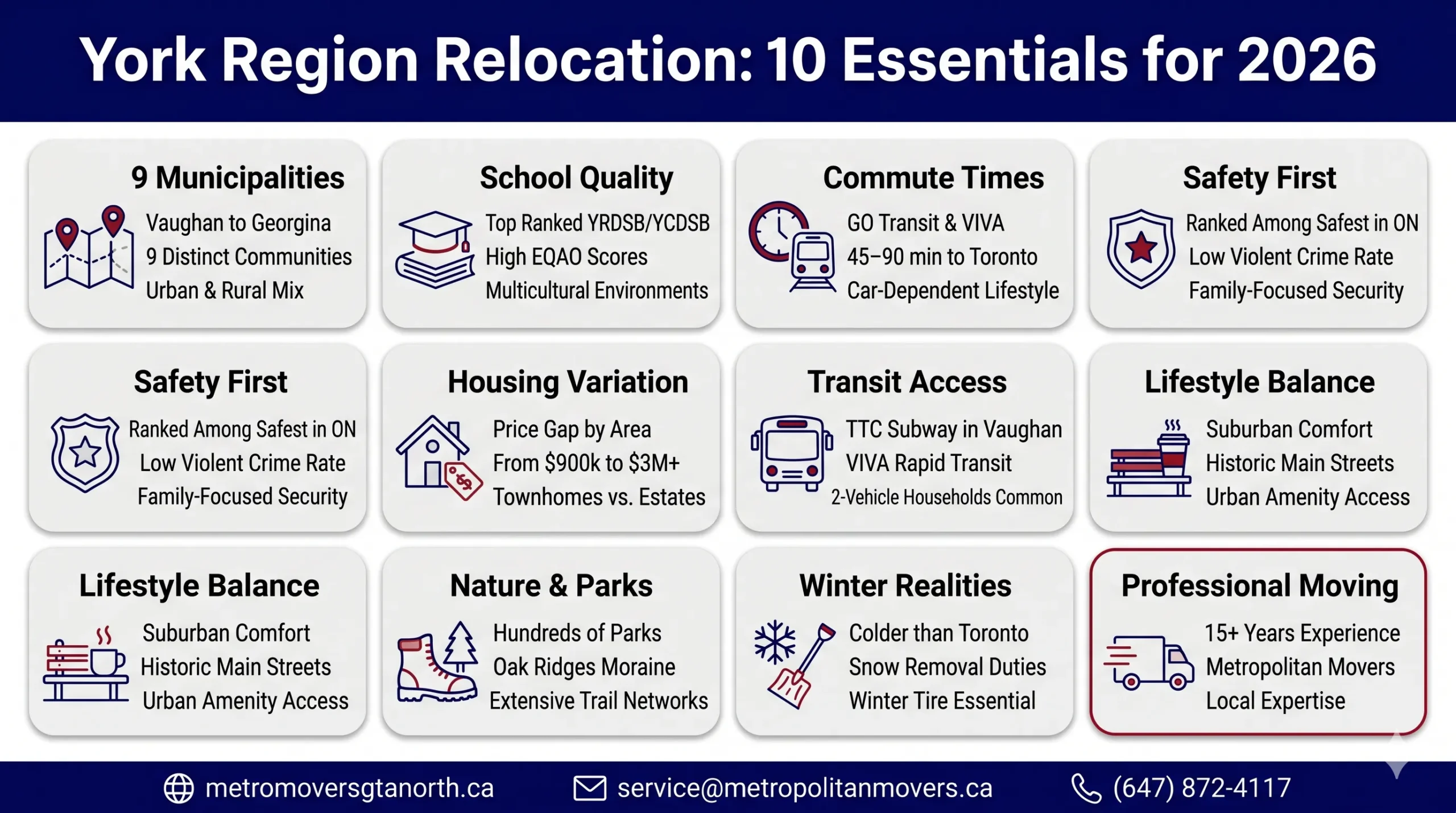
The first critical insight about moving to York Region is understanding that “York Region” functions as a regional municipality governing nine separate towns and cities, each with distinct character, demographics, infrastructure, and housing markets. Vaughan operates as York Region’s largest and most urban municipality with subway access and high-density development. Markham ranks as the region’s most multicultural city with the highest Asian population percentage in Canada. Richmond Hill balances urban and suburban areas across its geographic span from Yonge Street corridor density to Oak Ridges Moraine conservation lands. Aurora and Newmarket deliver small-town main street character combined with GO Transit access supporting Toronto commuters. East Gwillimbury, Georgina, King Township, and Whitchurch-Stouffville round out the region’s northern tier with rural, agricultural, and low-density residential character.
This municipal diversity means that moving to York Region requires choosing not just “York Region” broadly but which specific municipality aligns with your lifestyle priorities, commute requirements, housing budget, and school preferences. A family prioritizing subway access and urban amenities selects Vaughan. A household seeking authentic Chinese cuisine and multicultural community chooses Markham. A family wanting small-town walkability with GO Transit commute options targets Aurora or Newmarket. Understanding these distinctions prevents mismatched expectations where families assume all York Region communities deliver identical suburban experiences.
The GTA North Neighbourhood Luxury Living Guide provides comprehensive municipality comparisons across schools, amenities, transit, and lifestyle factors. For municipality-specific moving logistics, Metropolitan Movers GTA North serves Vaughan, Markham, Richmond Hill, Aurora, and Newmarket with dedicated local expertise.
2. Cost of Living in York Region Varies Dramatically by Municipality and Neighbourhood
York Region cost of living spans from genuinely affordable to among Ontario’s most expensive depending on which municipality and neighbourhood you choose. Housing costs drive the widest variation. Detached homes in Richmond Hill’s Bayview Hill or Oak Ridges neighbourhoods exceed two million dollars regularly, while comparable properties in East Gwillimbury’s Mount Albert or Georgina’s Keswick trade under one million. Markham’s established neighbourhoods like Unionville command premiums for school quality and transit access, while newer Cornell and Wismer developments offer relative value for families prioritizing modern construction over established trees and walkability.
Property taxes also vary by municipality within York Region. Vaughan and Markham levy lower residential tax rates than Aurora and Newmarket, though absolute tax bills depend on assessed property values as much as rates. A nine hundred thousand dollar home in Aurora may generate comparable annual property tax to a one point two million dollar Markham property due to rate differentials offsetting assessment gaps.
Daily living costs including groceries, transportation, and recreation remain relatively consistent across York Region municipalities, though proximity to ethnic markets in Markham or big-box retail in Vaughan creates marginal cost variations. Families moving to York Region from Toronto proper generally experience housing cost increases offset by lower property taxes, while households relocating from smaller Ontario cities face sticker shock on both housing prices and property taxes despite suburban amenities justifying premiums for many.
For detailed affordability analysis across York Region municipalities, the GTA North Neighbourhood Luxury Living Guide breaks down housing costs, taxes, and total carrying expenses by area.
3. York Region Transit Through VIVA and YRT Creates Car-Dependent Reality for Most Residents
York Region transit operates through York Region Transit (YRT) local bus service and Viva rapid transit bus corridors, but the system does not replicate TTC subway convenience for most residents. Only Vaughan benefits from TTC subway access via the Yonge extension terminating at Vaughan Metropolitan Centre. The remainder of York Region relies on bus-based transit with service frequency, route coverage, and reliability creating car-dependent lifestyles for the vast majority of households.
Viva rapid transit routes along Yonge Street, Highway 7, and Davis Drive provide higher-frequency service connecting major nodes, but these corridors serve limited portions of York Region’s geographic area. Residents living outside quarter-mile walk radii of Viva routes depend on local YRT bus service operating at thirty-minute to one-hour frequencies on most routes. This service level makes transit commuting feasible only for residents with flexible schedules tolerating extended trip times or those living directly along high-frequency corridors.
GO Transit provides the primary rapid transit option for moving to York Region families commuting to downtown Toronto. Multiple GO Train stations across York Region including Vaughan Metropolitan Centre, Rutherford, Maple, King City, Aurora, Newmarket, and Stouffville offer express service to Union Station with trip times ranging from thirty-five to sixty-plus minutes depending on origin station. GO Transit frequency has improved materially with fifteen-minute all-day service on some lines, though outer stations maintain hourly or worse headways outside peak periods.
Most York Region households operate two vehicles due to transit limitations and suburban development patterns spreading destinations across wide geographic areas. Families moving to York Region from Toronto transit-dependent lifestyles must budget for vehicle acquisition, insurance, fuel, and maintenance representing substantial incremental monthly costs.
4. York Region Public Schools Rank Among Ontario’s Highest-Performing Districts
York Region public schools through York Region District School Board (YRDSB) and York Catholic District School Board (YCDSB) consistently rank among Ontario’s highest-performing school districts based on EQAO standardized test results, Fraser Institute rankings, and university acceptance rates. This school quality attracts families moving to York Region specifically for educational opportunities, with many households selecting neighbourhoods primarily based on elementary and secondary school catchments rather than commute access or amenities.
Markham schools dominate top provincial rankings with multiple elementary and secondary schools achieving Fraser Institute scores above nine out of ten. Richmond Hill’s schools similarly perform exceptionally, particularly in Bayview Hill, Jefferson, and Oak Ridges neighbourhoods. Vaughan schools show strong performance in established residential areas though newer developments still building school infrastructure show more variable quality. Aurora and Newmarket schools deliver solid academic performance combined with smaller school sizes appealing to families preferring intimate educational environments over large institutional high schools.
French Immersion programs operate across York Region school boards with varying availability by neighbourhood. Specialized programs including International Baccalaureate, STEM academies, and arts-focused schools provide alternatives to neighbourhood school assignments for families prioritizing program access over convenience.
School quality comes at a cost through housing premiums in top-ranked catchments. Properties feeding Unionville High School or Richmond Green Secondary School command fifty to one hundred thousand dollar premiums over comparable homes in lower-ranked catchments, representing capitalized value parents assign to educational quality.
For school-focused neighbourhood selection, the GTA North Neighbourhood Luxury Living Guide maps top-performing schools against housing costs and commute access by municipality.
5. Commuting From York Region to Downtown Toronto Requires Strategic Planning
York Region commuter tips for downtown Toronto employment start with understanding that daily commutes of sixty to ninety-plus minutes each way represent normal experiences for many residents. GO Transit provides the fastest option for most York Region origins, with express trains from Aurora, Newmarket, and Richmond Hill reaching Union Station in forty-five to sixty minutes during peak service. However, GO frequency limitations mean missing a single train adds thirty to sixty minutes to commute times, creating stress around work schedule flexibility.
Highway commuting from York Region faces severe congestion on Highway 404, Highway 400, and Highway 407 during peak periods. Residents commuting via Highway 404 from Markham or Richmond Hill experience stop-and-go conditions from Major Mackenzie southward through morning rush, with trip times from sixty to ninety-plus minutes depending on exact origin and Toronto destination. Highway 400 from Vaughan and King Township similarly suffers heavy congestion, though Vaughan subway access provides alternatives for residents near stations.
Reverse commutes from York Region to Mississauga, Brampton, or western Toronto destinations prove even more challenging due to limited east-west transit options and highway routes requiring circuitous routing. Families with employment in these areas should carefully evaluate whether York Region location makes sense given commute realities.
Hybrid work arrangements dramatically improve York Region livability by reducing commute frequency to two or three days weekly, transforming sixty-minute commutes from daily grind into manageable inconvenience. Families moving to York Region should secure hybrid work commitments before purchasing properties optimized for quality of life over commute proximity.
For families coordinating moves with employment transitions, Metropolitan Movers GTA North provides house moving service timing flexibility accommodating work schedules and transition periods.
6. York Region Lifestyle Balances Suburban Comfort With Urban Amenity Access
York Region lifestyle delivers suburban single-family housing, excellent schools, extensive parks and trails, and safe neighbourhoods while maintaining reasonable proximity to Toronto’s urban amenities, cultural institutions, and employment centres. This balance attracts families prioritizing child-rearing environments, homeownership, and outdoor access who also value occasional access to professional sports, museums, theatre, and diverse dining that suburban municipalities cannot replicate locally.
Each York Region municipality offers distinct lifestyle character. Vaughan combines suburban residential neighbourhoods with Vaughan Mills shopping, Canada’s Wonderland theme park, and growing urban density along Yonge Street. Markham delivers multicultural vibrancy through authentic Asian cuisine, cultural festivals, and retail density along Highway 7 that rivals urban environments. Richmond Hill balances urban Yonge corridor density with Oak Ridges ravine systems and conservation lands. Aurora and Newmarket offer walkable historic downtowns, farmers markets, and small-town community events alongside suburban residential subdivisions.
Recreation infrastructure across York Region includes hundreds of parks, extensive trail networks connecting municipalities, community centres with pools and arenas, and conservation areas protecting natural heritage. Families moving to York Region from Toronto apartments gain immediate access to yards, parks, and outdoor recreation supporting active lifestyles, though they sacrifice walkable restaurant districts and cultural programming that urban cores provide.
The GTA North Neighbourhood Luxury Living Guide explores lifestyle differences across municipalities in detail, helping families identify which York Region community matches their priorities.
7. York Region Safety Rankings Place Most Municipalities Well Above GTA Averages
York Region safety rankings consistently position the region’s municipalities among Ontario’s safest communities based on crime statistics, police presence, and resident safety perceptions. Aurora, Newmarket, King Township, Whitchurch-Stouffville, and East Gwillimbury report crime rates well below provincial averages with particular strength in low violent crime incidence. Markham, Richmond Hill, and Vaughan show slightly elevated property crime rates due to higher population density and proximity to major highways facilitating theft and break-and-enter activity, though violent crime remains below provincial norms.
York Regional Police deploy resources across all nine municipalities with response times meeting provincial standards and community policing programs maintaining visible presence in commercial areas and residential neighbourhoods. Neighbourhood watch programs operate actively in many York Region communities, reflecting resident engagement in local safety rather than passive reliance on formal policing alone.
Families moving to York Region from urban Toronto cores often cite safety as a primary motivation, seeking neighbourhoods where children walk to school independently and play outdoors without constant supervision. This safety advantage comes at the cost of suburban sprawl, car dependence, and reduced diversity compared to urban environments where higher density concentrates both opportunity and crime.
School safety specifically ranks as a family priority, with York Region schools reporting minimal serious safety incidents and comprehensive safety protocols managing student wellbeing. The combination of safe neighbourhoods and safe schools creates child-rearing environments that justify housing cost premiums for many families.
For safety-focused neighbourhood selection guidance, the GTA North Neighbourhood Luxury Living Guide provides municipality-level crime data and community safety infrastructure analysis.
8. York Region Neighbourhood Selection Demands Understanding of Micro-Market Variations
York Region neighbourhood guide research reveals that broad municipality-level generalizations miss critical micro-market variations affecting daily quality of life, school quality, property values, and community character. Within Markham alone, neighbourhoods range from Unionville’s heritage village charm and Thornhill’s established Jewish community to Cornell’s new subdivision feel and Cathedraltown’s condo towers. Richmond Hill spans from Bayview Hill estates and Oak Ridges ravine properties to Yonge corridor high-rises and highway-adjacent townhomes. Vaughan encompasses Kleinburg’s rural estate character, Maple’s working-class suburbs, and Vaughan Metropolitan Centre’s urban towers.
These neighbourhood differences manifest in school quality variations, with top-ranked schools concentrating in specific pockets rather than spreading evenly across municipalities. Housing affordability also varies dramatically within single municipalities, with Markham detached homes ranging from nine hundred thousand to three million-plus depending on neighbourhood, lot size, and school catchment.
Walkability differences prove particularly stark, with heritage main streets in Unionville, Aurora, and Newmarket delivering pedestrian-oriented retail and dining while newer subdivisions require driving for all errands and recreation. Families prioritizing walkable lifestyles must target specific York Region neighbourhoods rather than assuming suburban character prevents pedestrian-friendly environments.
The GTA North Neighbourhood Luxury Living Guide provides granular neighbourhood analysis within each municipality, identifying which pockets deliver specific lifestyle and value combinations families seek.
For families finalizing neighbourhood selection and coordinating moves, Metropolitan Movers GTA North offers local moving service expertise navigating York Region’s diverse residential geography.
9. Moving to York Region Requires Understanding Seasonal Climate and Snow Removal Realities
Moving to York Region from Toronto introduces marginal but noticeable climate differences due to York Region’s northern position and distance from Lake Ontario’s moderating influence. Winter temperatures run two to four degrees colder than downtown Toronto, and snowfall totals exceed Toronto by ten to twenty percent annually. These differences matter for heating costs, vehicle winter tire requirements, and lifestyle adjustments around outdoor winter activity.
Snow removal responsibilities fall to individual homeowners for detached and semi-detached properties, requiring equipment ownership or service contracts for driveway and walkway clearing. Families moving to York Region from Toronto condos or apartments often underestimate the time and cost burden of snow removal, particularly during heavy snowfall events requiring multiple clearing sessions daily. Snowblower purchases of eight hundred to fifteen hundred dollars or seasonal service contracts of four hundred to eight hundred dollars represent incremental costs absent from urban condo living.
Municipal snow plowing prioritizes major roads and bus routes, with residential streets receiving lower priority creating periods where side streets remain snow-covered for days after storms. This reality requires vehicle winter capability and resident patience with imperfect road conditions unlike downtown Toronto’s aggressive clearing.
Summer temperatures in York Region also run slightly warmer than lakefront Toronto, increasing air conditioning demands and energy costs. Households should budget for higher seasonal utility expenses compared to urban apartment living where building systems and shared walls reduce individual climate control costs.
10. York Region Moving Logistics Involve Specific Challenges Requiring Professional Coordination
York Region moving logistics present operational challenges that differ from urban Toronto or suburban Mississauga relocations. Many York Region subdivisions feature winding streets, cul-de-sacs, and limited truck access requiring smaller vehicles or shuttle services between full-size moving trucks staged on main roads and final destinations on interior streets. Condo and townhome developments often enforce strict move-in/move-out windows, elevator booking requirements, and moving truck staging rules that demand advance coordination with property management.
Seasonal timing affects York Region moves more than Toronto urban relocations due to weather impacts on loading and unloading operations. Winter moves between November and March face snow accumulation on driveways and walkways, icy conditions creating safety hazards, and extreme cold affecting furniture and appliance handling. Summer moves during July and August face heat stress on moving crews and temperature-sensitive items requiring climate control during transit.
Long-distance moves into York Region from other provinces or distant Ontario cities require strategic staging and timing to avoid extended hotel stays or temporary housing if closing dates and moving truck arrival do not align perfectly. Professional movers coordinate these timelines, managing logistics that DIY moves struggle to execute smoothly.
Metropolitan Movers GTA North provides comprehensive moving services across all York Region municipalities including packing and unpacking service, piano moving service for specialty items, senior moving service for downsizing relocations, and storage moving service for transition periods. Specific services address municipality-specific needs including Aurora packing moving, Richmond Hill storage, and Newmarket furniture removal.
Moving to York Region: Your Complete Decision Framework
Moving to York Region delivers suburban quality of life, excellent schools, safe neighbourhoods, and housing value that Toronto proper cannot match at equivalent price points. The trade-offs include car dependence, lengthy commutes for downtown employment, and suburban character lacking urban walkability and cultural density. For families prioritizing child-rearing environments, homeownership, and outdoor access, these trade-offs justify York Region selection. For households valuing transit access, walkability, and urban amenities, Toronto core or transit-rich GTA nodes deliver better lifestyle matches despite higher housing costs.
The nine municipalities comprising York Region offer vastly different characters, costs, and lifestyle experiences. Vaughan provides subway access and urban density. Markham delivers multicultural vibrancy and top schools. Richmond Hill balances urban and suburban across its geographic span. Aurora and Newmarket offer small-town charm with GO Transit commute options. Understanding these distinctions prevents mismatched expectations and buyer’s remorse.
For the complete municipality-by-municipality comparison framework covering schools, transit, lifestyle, safety, and costs, the GTA North Neighbourhood Luxury Living Guide provides the comprehensive analysis families need. When your York Region destination is finalized, Metropolitan Movers GTA North coordinates every operational detail from packing through final placement. Explore the full services page or contact the team to begin planning your York Region relocation.