
Every household that decides to live in York Region faces the same fundamental question before committing to an address: how does the commute from GTA North to downtown Toronto actually work in real life? Not the optimistic navigation app estimate generated at 2 AM on a Sunday — but the honest, daily reality of getting from Aurora, Richmond Hill, Newmarket, Vaughan, or Markham to Union Station, the Financial District, or Bay Street on a Tuesday morning in November. The transit infrastructure, highway conditions, fare structures, and remote work equation have all shifted meaningfully heading into 2026. This guide covers every dimension of the GTA North commute — from GO Transit schedules and VIVA bus rapid transit routes to Highway 404 traffic patterns, monthly transit pass costs, and the increasingly relevant question of whether the remote work vs commuting Toronto calculation still makes a suburban address financially rational. For the full geographic and lifestyle context of living in GTA North that surrounds this commute equation, the GTA North Luxury Living Neighborhood Guide provides the complete regional framework.
Why the Commute GTA North Question Has Fundamentally Changed Since 2022
The GTA North conversation in 2026 operates in a completely different context than it did before the pandemic permanently restructured how professional households approach work, geography, and the daily transit reality. Three structural shifts have altered how York Region residents think about their downtown Toronto connection.
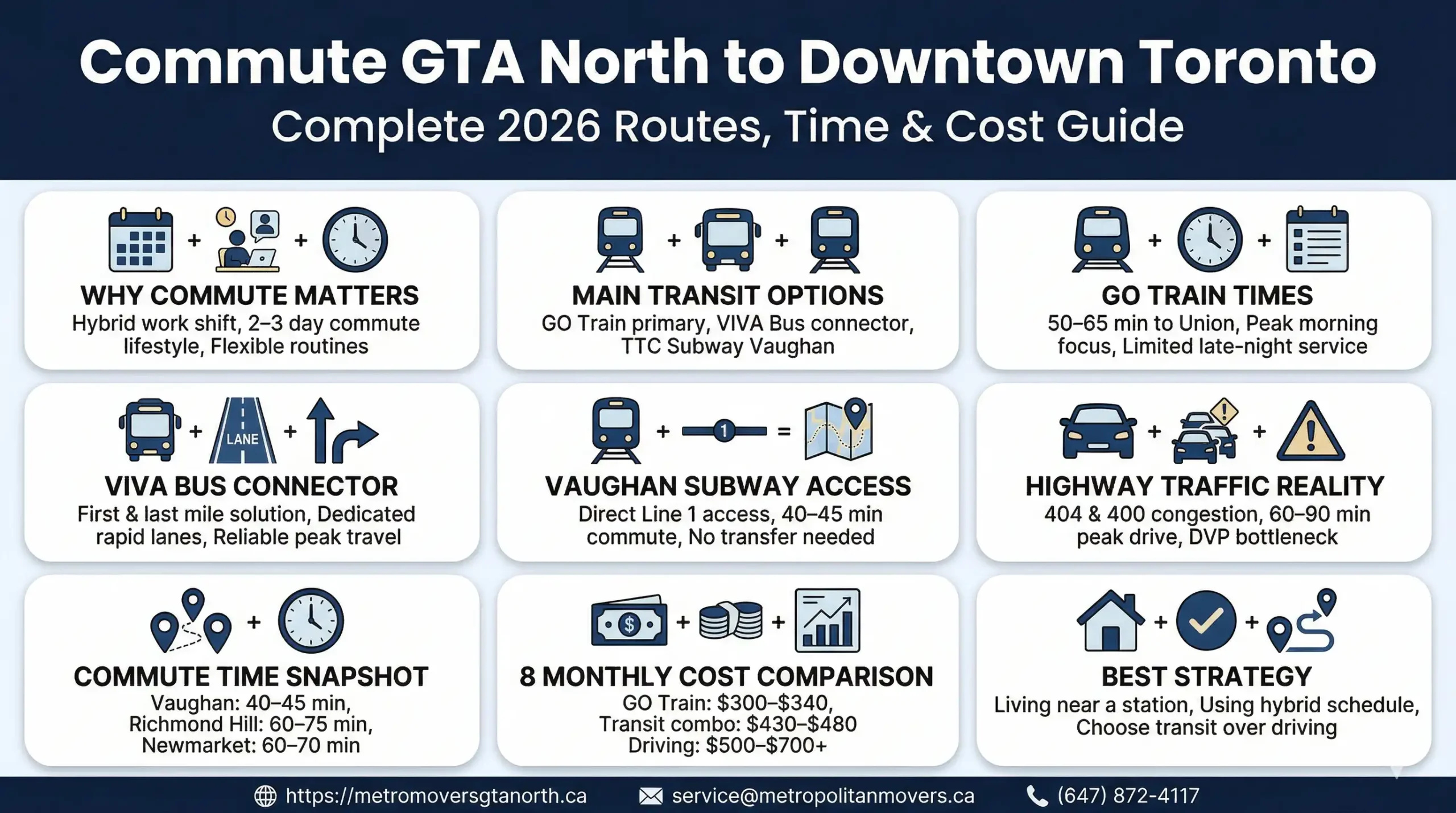
First, hybrid work schedules have reduced the five-day commute obligation for a significant proportion of GTA North residents. Many professionals now commute two or three days per week rather than five, which changes the monthly cost mathematics and reduces the pain threshold of a 60-minute transit trip considerably. A 60-minute GO Train ride that you take Tuesday and Thursday is a fundamentally different lifestyle burden than the same trip repeated Monday through Friday without interruption. The fatigue curve is incomparable.
Second, the TTC subway extension Vaughan — specifically the Vaughan Metropolitan Centre station at the northern terminus of Line 1 — permanently expanded direct subway access into York Region, giving Vaughan residents a one-seat ride into Toronto’s core without GO Train transfers or additional connections. This single infrastructure investment reshaped the entire Vaughan commute equation.
Third, fare integration through the Ontario One Fare program has materially reduced the financial penalty of multi-system commutes across the region. Riders transferring between York Region Transit, GO Transit, and the TTC now face significantly reduced double-fare scenarios compared to the fragmented pricing structure of prior years. This change makes transit commuting from GTA North more financially competitive against driving than it has ever been at any point in the region’s history.
GO Transit Schedules: The Rail Backbone of the GTA North Commute
GO Transit schedules form the primary commuting infrastructure for the majority of GTA North residents who work in downtown Toronto. GO Transit’s Barrie, Stouffville, and Richmond Hill rail lines connect Aurora, Newmarket, King City, Stouffville, and Richmond Hill directly to Union Station. Understanding which line serves your specific community, what the actual departure windows look like during peak hours, and where the service gaps fall determines whether GO Transit works as your primary commute mechanism or requires supplemental transit layering to function reliably.
Barrie Line — Serving Aurora, Newmarket, and King City:
The Barrie Line is the primary rail artery for Aurora and Newmarket residents heading downtown. Peak morning departures from Aurora GO typically run between 6:00 AM and 8:30 AM, with trains arriving at Union Station in approximately 55–65 minutes depending on the specific departure. Newmarket GO departures sit approximately 5–10 minutes ahead of Aurora departures on the same corridor. King City GO station sits north of Aurora on the same Barrie Line, adding a further segment northward.
The critical limitation of Barrie Line service that every prospective GTA North commuter must understand is its peak-direction dependency. Inbound morning and outbound evening trains are well-serviced, but mid-day and late-evening frequencies drop substantially. For professionals with irregular schedules, client-driven evening obligations, or return trips pushing past 7:30 PM consistently, the GO Train requires a reliable backup plan rather than functioning as a standalone commute solution.
Richmond Hill Line:
The Richmond Hill Line connects Richmond Hill GO station to Union Station in approximately 50–60 minutes during peak service windows. This corridor has historically offered less frequency than the Barrie Line, making schedule adherence more critical — missing a train can mean a 30–40 minute wait rather than the short cycle that higher-frequency lines deliver. Richmond Hill commuters who build tight morning routines around a specific departure time navigate this corridor most successfully.
Stouffville Line — Serving Markham and Stouffville:
Markham residents commuting via GO Transit primarily use the Stouffville Line, connecting Unionville, Centennial, and Stouffville GO stations to Union Station in approximately 50–65 minutes during peak service. The Stouffville corridor serves one of York Region’s most transit-oriented commuter populations, with strong ridership and well-established commute routines built around the departure schedule.
Ride to GO Fare Integration:
York Region Transit operates a Ride to GO program that allows commuters to use YRT and VIVA bus connections to reach their GO station without paying a separate fare. When tapping with a PRESTO card, the YRT first-leg connection to the GO station does not trigger an additional charge beyond the GO fare itself. This integration eliminates a meaningful cost and friction barrier that previously discouraged multi-leg transit use across York Region communities.
VIVA Bus Rapid Transit: The Regional Connector That Bridges the First and Last Mile
VIVA bus rapid transit operates as York Region Transit’s premium express bus network, running along dedicated bus-only lanes on major regional arterials including Yonge Street, Davis Drive, Highway 7, and 16th Avenue. For GTA North commuters who do not live within walking distance of a GO station, VIVA fills the critical first-mile gap — connecting residential neighborhoods to GO Train stations and TTC terminal points faster and more reliably than standard mixed-traffic bus routes.
The dedicated rapidway infrastructure on Yonge Street between Newmarket and Richmond Hill provides a significantly faster and more predictable bus experience than standard arterial routes. Buses operating in dedicated lanes bypass the peak-hour congestion that reduces mixed-traffic service to a crawl along Yonge during high-volume morning windows — a structural advantage that makes VIVA commute times consistent and plannable rather than variable and anxiety-producing.
Key VIVA routes for GTA North commuters:
- vivaBlue (Yonge Street corridor): Runs the full length of Yonge Street through York Region, connecting Newmarket and Aurora GO stations southward through Richmond Hill to Finch subway station and Finch GO Bus Terminal. This is the backbone VIVA route for commuters along the Yonge Street axis.
- vivaPurple (Highway 7 corridor): Connects Markham, Thornhill, and Vaughan along Highway 7, linking major employment nodes across the York Region east-west axis and providing connections to Unionville GO and the Vaughan Metropolitan Centre.
- vivaOrange and vivaGreen routes: Serve Davis Drive in Newmarket and secondary arterials across the region, bridging residential communities to the primary VIVA rapidway corridors.
For commuters originating in Newmarket or Aurora, vivaBlue provides a direct, reliable connection to their respective GO stations that eliminates the need for a personal vehicle during the first leg of the downtown commute entirely. The combination of vivaBlue to Newmarket GO and the Barrie Line train to Union Station creates one of the strongest non-driving commute chains available anywhere in York Region for residents without walkable GO station access.
The TTC Subway Extension Vaughan: What Direct Subway Access Actually Delivers
The TTC subway extension Vaughan — formally the Toronto-York Spadina Subway Extension — fundamentally altered the commute calculus for Vaughan residents when the Vaughan Metropolitan Centre station opened and continues to define VMC as GTA North’s premier transit-oriented development node heading into 2026.
Vaughan Metropolitan Centre provides direct TTC Line 1 subway access, reaching Union Station in approximately 40–45 minutes. For Vaughan residents living within walking or cycling distance of VMC station, this represents a completely different commute experience from the GO Train alternative. There are no departure schedule constraints — the subway runs continuously through the day and into the evening without the peak-direction limitations that restrict GO Train flexibility. There are no transfer risks — you board at VMC and ride continuously to Union, King, Queen, or Bloor-Yonge without any connection dependency. And the all-day, all-week frequency means a missed train is a 3-minute inconvenience rather than a 30-minute schedule disruption.
For residents relocating from Toronto into Vaughan’s VMC corridor as part of a lifestyle or budget repositioning decision, the subway connection eliminates the commute penalty that historically defined York Region living for downtown workers. Properties within the 10-minute walk radius of VMC command premium pricing specifically because buyers and renters recognize the structural transit advantage — and that premium is justified by the daily lived experience it delivers. Families and individuals considering relocating to Vaughan can rely on house moving services to manage their complete residential transition into the VMC corridor with precision.
Highway 404 Traffic Patterns: The Driving Reality for GTA North Commuters
For GTA North residents whose employment destinations fall outside the downtown core transit network — suburban office parks, industrial areas, or destinations not served efficiently by GO or TTC — driving remains the primary commute mode. Understanding Highway 404 traffic patterns and the broader highway geography of the York Region corridor determines whether you arrive at work on schedule or spend your morning trapped in gridlock that systematically erodes both your schedule and your energy reserves.
Highway 404 / Don Valley Parkway Corridor:
Highway 404 serves as the primary north-south driving artery for Markham, Stouffville, and communities along York Region’s eastern axis. Southbound morning congestion on Highway 404 typically begins accumulating between 7:00 and 7:15 AM, reaching peak density between 7:45 and 8:45 AM. The transition point where 404 merges into the Don Valley Parkway south of Sheppard Avenue introduces a compounding bottleneck — the DVP is one of the GTA’s most consistently congested corridors during morning rush hour, and the combined 404-DVP sequence from Markham to the downtown core can consume 60–90 minutes during peak windows, compared to the 35-minute off-peak drive time the same route delivers on a Saturday morning.
Highway 400 / Allen Road Corridor:
Vaughan and King City commuters driving downtown primarily use Highway 400 southbound connecting to the Allen Expressway. This corridor mirrors the 404 congestion profile in its timing — clear at 6:15 AM, building by 7:00 AM, and heavily congested from 7:30 through 9:00 AM. The Allen Road narrowing south of Lawrence Avenue creates a structural bottleneck that cannot be physically widened, and Vaughan residents who miss the 6:45–7:00 AM departure window frequently find their driving commute extending to 75 minutes or beyond during peak congestion periods.
Highway 407 ETR — The Toll Alternative:
Highway 407 runs as a fully electronic toll road across the top of the GTA, providing an east-west connection that largely bypasses the congestion concentrations on 400 and 404. The 407 charges based on distance traveled and time of travel, with peak-hour rates on weekday mornings representing the highest cost tier. For GTA North commuters who value time over toll cost, the 407 delivers a consistently faster east-west commute. However, the daily toll for a round-trip commute route using a substantial 407 distance can add $300–$500 per month in toll costs alone — making the financial case for GO Transit considerably stronger for most household budgets when this toll burden is factored into the full cost comparison.
Commute Time Richmond Hill to Toronto: A Realistic Window Breakdown
Commute time Richmond Hill to Toronto varies dramatically based on departure time, chosen route, and specific destination within the downtown core. The windows below reflect the realistic 2026 commute experience rather than theoretical best-case estimates generated under ideal conditions.
By GO Train (Richmond Hill Line):
- Richmond Hill GO station to Union Station: approximately 50–60 minutes during peak service
- YRT or VIVA bus connection from residential address to Richmond Hill GO: approximately 10–15 minutes
- Total door-to-Union time: approximately 60–75 minutes from most Richmond Hill residential addresses
- Final-mile connection to specific downtown employment destination: 5–20 minutes via TTC or walking, depending on location
By Car (Yonge Street / Highway 404 corridor):
- Departing before 6:30 AM: approximately 35–45 minutes to the downtown core
- Departing 7:00–7:30 AM: approximately 50–65 minutes
- Departing 7:30–8:30 AM: approximately 65–90 minutes, with occasional exceedance during peak congestion events
- Downtown parking costs: $25–$40 per day in Financial District facilities, adding $500–$800 per month to the driving commute total
By YRT / VIVA (Bus-Only Commute):
For Richmond Hill residents without GO station access or parking availability, the all-bus commute via vivaBlue to Finch subway and Line 1 southbound delivers a 70–90 minute total trip time. Longer than the GO Train option but offering greater schedule flexibility and a lower overall cost structure, particularly for hybrid workers who commute fewer than five days per week.
Residents of Richmond Hill relocating specifically to optimize their downtown commute access can use Richmond Hill storage and moving services to manage their transition smoothly when closing dates and occupancy timelines create a gap between properties.
Monthly Transit Pass Costs: Building Your GTA North Commute Budget
Monthly transit pass costs for GTA North commuters depend on which transit systems your specific commute route engages and how many days per week you actually travel downtown. The following represents the realistic 2026 cost landscape for York Region commuters planning their monthly transportation budget.
GO Transit Monthly Pass:
GO Transit applies distance-based fare pricing, meaning monthly pass costs vary by the specific station pair your commute covers. A monthly pass for the Newmarket-to-Union or Aurora-to-Union corridor runs approximately $300–$340 per month. Richmond Hill-to-Union monthly passes run approximately $240–$280. King City, as the furthest Barrie Line station from Union, sits at the top of the monthly pass cost range for GTA North commuters.
York Region Transit Monthly Pass:
A standard YRT monthly pass providing unlimited travel on all YRT and VIVA routes runs approximately $128–$140 per month. For commuters using YRT exclusively to connect to a GO station, the Ride to GO integration means the YRT bus connection does not add to the daily GO fare — the monthly YRT pass covers all intra-regional bus travel as a standalone cost.
Ontario One Fare Integration:
The Ontario One Fare program reduces the fare burden on commuters transferring between York Region Transit and the TTC at major terminal points including Finch, Sheppard-Yonge, and Bloor-Yonge. When transferring between systems using a PRESTO card, the second system fare is waived under the integration program — eliminating what was previously a full additional adult fare charge at these connection points. This change makes multi-system commutes from GTA North communities meaningfully cheaper than they were prior to the program’s implementation and strengthens the financial case for transit versus driving across the board.
Total Monthly Commute Cost Comparison:
- GO Train (Newmarket or Aurora to Union, monthly pass): approximately $300–$340 per month
- GO Train plus YRT monthly pass with Ride to GO integration: approximately $430–$480 per month total
- Driving via standard highways with downtown parking: approximately $500–$700 per month depending on vehicle fuel consumption and parking arrangement
- Driving via Highway 407 with parking: approximately $800–$1,100 per month depending on toll distance and parking facility
The financial mathematics consistently favor GO Transit for pure downtown-Toronto commuters, particularly when hybrid work schedules allow pay-per-trip pricing rather than full monthly pass purchase. For a two-day commuter using pay-per-trip GO fares, the monthly transit cost drops dramatically compared to any driving alternative.
Park and Ride Locations: The Gateway Infrastructure for GTA North GO Commuters
Park and Ride locations throughout York Region represent a piece of the commute infrastructure that first-time GTA North residents frequently overlook during their neighborhood evaluation process. The presence, capacity, and utilization patterns of parking at GO stations directly determine whether the GO Train is a practical daily option for your specific address or requires supplemental transit connections to access reliably.
- Aurora GO Station: Substantial surface parking with daily and monthly permit options available. The Aurora GO Park and Ride fills rapidly on weekday mornings — early arrival before 7:00 AM is typically required to secure an unpermitted spot during peak commute season.
- Newmarket GO Station: Large Park and Ride capacity serving the Newmarket and East Gwillimbury commuter base. A recently expanded parking structure at Newmarket GO improved the capacity constraints that previously made very early arrival essential for commuters without monthly permits.
- Richmond Hill GO Station: Surface and structured parking serving the Richmond Hill Line commuter base. Monthly permits provide reserved allocation for consistent commuters who value guaranteed space availability over the flexibility of unpermitted daily parking.
- King City GO Station: Smaller surface parking lot serving the King City and Nobleton commuter base on the Barrie Line. This station fills earliest relative to its capacity — commuters without monthly permits should plan 6:15–6:30 AM arrivals to secure parking consistently.
- Markham-area GO Stations (Unionville, Centennial, Stouffville): Surface parking at all three stations, with Unionville GO typically experiencing the highest utilization pressure given Markham’s employment density and the concentration of residential development surrounding the station.
Monthly parking permit applications for high-demand GO stations can involve waitlists during peak periods. Prospective GTA North residents should confirm their nearest GO station’s parking availability before finalizing their address selection — the distinction between walking distance from a GO station and a driving connection requiring an available parking spot is a material difference in the daily commute experience.
Remote Work vs. Commuting Toronto: The 2026 Decision Framework
The remote work vs commuting Toronto calculation represents the most consequential financial and lifestyle question that GTA North residents navigate when selecting their residential address and structuring their employment expectations. The analysis has shifted substantially since remote and hybrid work normalized across the professional landscape, and understanding the current state of this equation is essential to making a York Region address decision that holds up over multiple years.
The case for committing to GTA North with hybrid work:
If your employment structure offers two to three in-office days per week, the GTA North value proposition becomes exceptionally strong. You absorb a 60–75 minute commute two or three times weekly — which the vast majority of hybrid professionals find entirely manageable, particularly on comfortable GO Train cars where reading, laptop work, podcasts, and genuine decompression time are all viable. In exchange, you access a significantly larger home, quieter streets, immediate conservation trail access, and the suburban lifestyle that downtown Toronto pricing has made structurally inaccessible to most professional households.
The cost savings are real and substantial: the property premium of downtown Toronto versus comparable space in Newmarket, Aurora, or Markham often represents six figures in purchase price and several hundred dollars per month in mortgage carrying costs. Even accounting for $300–$400 monthly in GO Transit pass costs, GTA North residents on hybrid schedules frequently save $600–$1,000 or more per month in total housing costs compared to downtown-equivalent properties — a gap that compounds meaningfully over the years of a typical residential tenure.
The case for caution with full-time in-office requirements:
If your employment genuinely requires five-day in-person presence with no schedule flexibility, the commute GTA North equation tightens considerably. A 65-minute daily GO Train commute represents approximately 2 hours and 10 minutes of daily transit time — roughly 45–50 hours per month. Many professionals find this time productive and manageable, using it for focused reading, work preparation, or genuine mental separation between work and home. Others find the cumulative time cost unsustainable within 18–24 months, ultimately relocating closer to downtown to recover their daily schedule. The honest assessment: five-day downtown commuters should evaluate their personal tolerance for sustained daily transit time before committing to a Newmarket or Aurora address — not after signing a purchase agreement.
Highway vs. Transit: Choosing Your Primary Commute Mode by Community
Selecting the right commute mode when you plan to commute GTA North depends directly on your specific municipality, your downtown destination, your work schedule, and your personal tolerance for the trade-offs each option delivers on a daily basis.
- Vaughan residents: The VMC TTC subway is the dominant recommendation for downtown commuters. It delivers all-day frequency, zero schedule dependency, and the full TTC network at the destination. Driving from Vaughan to downtown Toronto via Highway 400 is the weakest value proposition in the York Region commute landscape given peak-hour congestion and downtown parking costs combined.
- Richmond Hill residents: GO Train via the Richmond Hill Line combined with a vivaBlue first-leg connection represents the strongest commute chain available. Driving adds cost variability and significant time variability during peak windows without delivering meaningful average time savings over the rail alternative.
- Aurora and Newmarket residents: GO Train on the Barrie Line is the anchor commute option for both communities. The 55–65 minute ride to Union Station, paired with a VIVA connection to the GO station, creates a manageable and cost-effective daily commute for hybrid workers. Full-time commuters should structure their morning routines around the peak-direction GO service departure windows that define this corridor’s schedule. For those moving to Newmarket specifically to leverage this transit corridor, local moving services in Newmarket position you precisely in the address that serves your commute from day one.
- Markham residents: Both GO Bus and the Stouffville Line GO Train operate through this corridor. The Highway 404 driving alternative functions for off-peak commuters but deteriorates rapidly during the 7:30–8:30 AM window when DVP congestion compounds the 404 delay.
- King City residents: The Barrie Line GO Train remains the primary downtown commute option, though the limited Park and Ride capacity at King City GO means either an early arrival discipline or a VIVA/YRT connection strategy is necessary for reliable daily parking access.
Union Station Connection: What Happens After You Arrive
The Union Station connection experience at the downtown terminus of your GTA North commute determines how efficiently you cover the final mile to your specific employment destination. Union Station serves as the central transit hub connecting GO Transit, TTC, UP Express, VIA Rail, and various regional bus services under a single massive infrastructure footprint in the heart of the downtown core.
From Union Station, downtown Toronto employment destinations are accessible via multiple onward connection methods:
- TTC subway Line 1 northbound: King, Queen, Dundas, College, and Bay Street corridor destinations within 5–10 minutes of boarding
- TTC streetcar network: King Street East and West, Queen Street, Spadina, and Bathurst corridors within 10–20 minutes depending on destination
- Walking: Bay Street financial district is accessible on foot within 10–15 minutes — many GO Train commuters walk directly from Union Station to their office buildings, eliminating the TTC connection entirely
- Bike Share Toronto: Docking stations immediately adjacent to Union Station provide access to the downtown cycling network for destinations within 2–3 kilometers of the station
The Union Station experience itself has improved with infrastructure investments in recent years, including concourse capacity expansions and improved TTC-GO connection flow that has reduced the friction of the transfer experience during high-volume morning arrival windows.
Park and Ride Infrastructure Is Expanding: What 2026 Looks Like
York Region and Metrolinx have both committed to expanding GO Station parking capacity as part of the broader regional transit growth strategy aligned with the GTA’s continued population expansion. Several Park and Ride expansion projects across the Barrie and Stouffville lines have either completed or are actively progressing, targeting the capacity constraints that currently force early arrivals at high-utilization stations like Aurora GO and King City GO.
For prospective GTA North residents evaluating transit-oriented addresses in 2026, the parking expansion trajectory means that stations currently experiencing high utilization pressure will gradually offer improved unpermitted daily parking availability — a change that expands the geographic radius from which GO Train commuting becomes practical without requiring either a monthly permit or a dedicated early-morning arrival discipline.
| GTA North Community | Primary Transit Option | Transit Time to Union Station | Drive Time Peak Hour | Monthly Transit Cost | Park & Ride Availability |
|---|---|---|---|---|---|
| Vaughan (VMC) | TTC Line 1 Subway — Direct | ~40–45 minutes | 55–80 min via Hwy 400 | ~$156/month (TTC monthly) | Limited — Subway-adjacent street parking |
| Richmond Hill | GO Train (Richmond Hill Line) | ~50–65 minutes (train only) | 50–80 min via Yonge / Hwy 404 | ~$240–$280/month (GO monthly) | Good — Surface and structured |
| Aurora | GO Train (Barrie Line) | ~55–65 minutes | 60–90 min via Yonge / Hwy 400 | ~$300–$330/month (GO monthly) | Good — Fills early, arrive by 7 AM |
| Newmarket | GO Train (Barrie Line) | ~60–70 minutes | 70–100 min peak hour | ~$320–$340/month (GO monthly) | Excellent — Expanded parking structure |
| Markham | GO Train (Stouffville Line) / GO Bus | ~50–65 minutes | 55–90 min via Hwy 404 / DVP | ~$220–$260/month (GO monthly) | Good — Multiple station options |
| King City | GO Train (Barrie Line) | ~65–75 minutes | 65–95 min via Hwy 400 | ~$340–$360/month (GO monthly) | Limited — Fill by 6:30 AM, permit recommended |
Planning Your Move Around Your Commute: How Address Selection Changes Everything
The single most consequential commute decision you make in GTA North happens before you ever board a GO Train — it happens when you choose your specific residential address. The difference between living 800 meters from Aurora GO station and living 4 kilometers away is the difference between a 10-minute walk and a 10-minute drive requiring available parking. The difference between a Vaughan address within the VMC subway catchment and a Vaughan address in Woodbridge that requires a bus connection adds 20–30 minutes to your daily commute and removes the scheduling flexibility that makes GTA North genuinely livable for high-frequency commuters.
When your residential address decision is being finalized around commute optimization, the relocation itself must be executed with the same precision you applied to the address selection. Same-day moving capacity handles urgent relocations when commute-critical address changes cannot wait for conventional booking timelines. For planned transitions where downsizing from a larger suburban home is part of the move to a more transit-optimal address, our team manages the full inventory reduction process from sorting through to final placement. For seniors adjusting their address around healthcare and transit proximity simultaneously, senior moving services apply the specialized, patient-forward approach these transitions require. And for moves originating outside York Region entirely — from another Ontario city or another province — long-distance moving coordination manages the full cross-regional transition under continuous inventory monitoring throughout the journey.
Frequently Asked Questions About the GTA North Commute
Is the GO Train from Newmarket to Union Station worth the commute time?
For hybrid workers commuting two to three days per week, the Newmarket-to-Union GO Train is absolutely viable and financially advantageous compared to downtown Toronto housing costs. For five-day in-office commuters, the 60–70 minute one-way travel time requires a genuine personal assessment — many find the GO Train environment productive and entirely manageable over the long term, while others find the cumulative weekly time cost unsustainable. The honest answer depends on your specific daily routine tolerance and how productively you use transit time.
What is the cheapest daily commute option from GTA North to downtown Toronto?
The cheapest commute structure depends on frequency. For full-time five-day commuters, a GO Transit monthly pass provides the best per-trip unit cost. For hybrid two-to-three-day commuters, pay-per-trip GO fares with PRESTO often outperform monthly pass purchases mathematically. In all frequency scenarios, transit outperforms driving on pure cost once downtown parking, daily fuel, and vehicle depreciation are all factored into the driving calculation honestly.
Does the VIVA bus run frequently enough for a reliable daily commute?
VIVA rapidway service on the Yonge Street corridor operates on 5–10 minute headways during peak morning hours — frequent enough to serve as a reliable first-leg connection to GO stations or Finch subway. Outside peak hours, headways extend to 15–20 minutes, which remains adequate for flexible schedules and hybrid work patterns. The dedicated rapidway lanes provide meaningful protection from arterial congestion that makes standard mixed-traffic bus routes unreliable along Yonge Street during high-volume periods.
How does Highway 404 compare to Highway 400 for morning commute performance?
Both corridors experience severe peak-hour congestion, but the specific bottleneck dynamics differ. Highway 404 transitions into the Don Valley Parkway — one of the GTA’s most consistently congested corridors — creating a compounding effect south of Sheppard Avenue that 400 and Allen Road commuters do not experience in the same form. Both corridors offer near off-peak travel times for commuters disciplined enough to depart before 6:45 AM on weekday mornings.
How does Metropolitan Movers GTA North support commute-driven relocation decisions?
Metropolitan Movers GTA North applies 15+ years of York Region moving expertise to address transitions driven entirely by commute optimization. Whether you are moving closer to a GO station, repositioning within Vaughan to access the VMC subway, or transitioning from a larger family home into a transit-adjacent townhouse or bungalow, our team manages every logistical detail. We handle packing and unpacking, furniture removals for items that do not fit the new layout, appliance moving for full household transitions, and last-minute moving when lease or closing timelines compress the available window without warning.
Making Your GTA North Commute Work Starts With the Right Address
The commute GTA North decision is ultimately not just about transit schedules and highway congestion data. It is about identifying the specific address within York Region that positions you closest to your preferred commute corridor, within the school catchment your family needs, in the community character that genuinely fits your daily lifestyle — and then executing the physical move into that address with complete precision. Metropolitan Movers GTA North applies 15+ years of regional moving expertise to every relocation across Aurora, Richmond Hill, Newmarket, Vaughan, and Markham. From local moving services for intra-region address transitions to manpower support for households who have secured their own transport but need experienced physical labor, our full service offering covers every dimension of your GTA North relocation. The right commute begins with the right address — and the right address begins with a move executed by a team that knows York Region’s streets, station access points, and neighborhood transit realities as thoroughly as you will once you have lived here for a year. Reach out to Metropolitan Movers GTA North today, and make your first commute from your new home the beginning of the balanced, financially rational, and genuinely livable GTA North life you relocated here to build.