
Not every move is a stack of cardboard boxes and a rented truck. When your property contains a concert grand piano, irreplaceable fine art, a commercial-grade safe, a custom home gym, sensitive IT infrastructure, or a collection of antiques with generational value, the logistics category you are operating in changes entirely. Specialized and white-glove moving services require a fundamentally different approach — different equipment, different crew training, different material science, and a different operational standard from the first consultation to the final placement at the destination.
This guide covers every high-value specialty move category that GTA North residents, business owners, and families face — from pianos and pool tables to sensitive server equipment and hot tubs — with the full operational methodology behind each. Metropolitan Movers GTA North has delivered precision relocations across Richmond Hill, Vaughan, Markham, Aurora, and Newmarket for 15+ years, and this guide reflects the depth of that operational experience.
Why Standard Moving Protocol Fails High-Value and Specialty Items
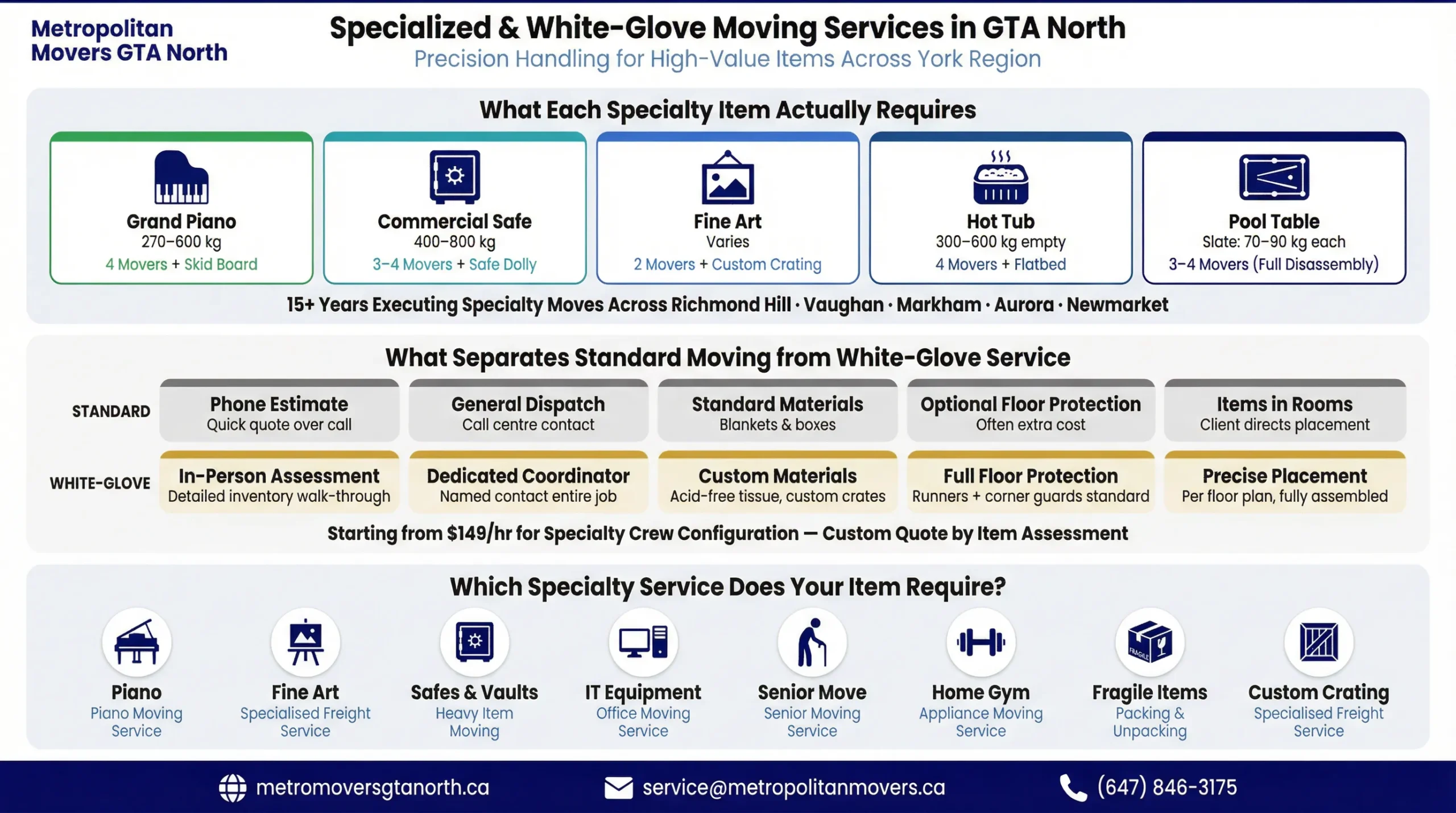
The majority of moving companies operating in GTA North are equipped and trained for standard household relocations — furniture, boxes, appliances. The moment a job involves a 650-kilogram Steinway grand piano, a custom-built home gym with Olympic-rated squat racks, or a fireproof double-door commercial safe, standard protocol creates real risk of both asset damage and crew injury.
Specialized and white-glove moving services exist because the engineering requirements for moving a nine-foot concert piano differ entirely from moving a sectional sofa. The centre of gravity is different. The structural fragility is different. The disassembly and reassembly protocol is different. The floor protection requirements are different. The vehicle loading geometry is different.
Every specialty category in this guide requires its own dedicated methodology. What follows is the complete operational breakdown for each, built specifically for GTA North property types, building access constraints, and seasonal conditions.
Piano Moving in Richmond Hill and Across York Region: Weight, Structure, and Safety
Piano moving is the single most technically demanding routine specialty move in residential relocation. A standard upright piano weighs between 180 and 270 kilograms. A baby grand ranges from 270 to 400 kilograms. A full concert grand can exceed 600 kilograms. Beyond raw weight, a piano’s structural design concentrates load in unpredictable ways — the cast iron plate alone accounts for the majority of the instrument’s mass, positioned asymmetrically relative to the cabinet exterior.
The Equipment Required for a Safe Piano Move:
- A purpose-built piano skid board — not a standard appliance dolly
- Four-point ratchet tie-down straps rated beyond the instrument’s total weight
- Minimum three trained movers for an upright; minimum four for any grand piano
- Moving blankets layered specifically around pedal assemblies, fallboard hinges, and leg attachment points
- A piano ramp system calibrated to the specific entrance gradient of both origin and destination properties
Upright Piano Protocol: An upright piano moves on its back on the skid board — never upright on a standard dolly. Before loading, the lid, music desk, and front panel are removed and wrapped individually. The keyboard lid is locked or secured with moving tape to prevent fallboard movement during transit. All four casters are checked for bearing integrity before the instrument bears any directional load on the skid.
Grand Piano Protocol: A grand piano requires partial disassembly before movement begins. The music desk, lid, and all three legs are removed and transported separately. The piano body is lowered onto its side onto the skid board using a controlled four-person lift — never a two-person attempt regardless of perceived crew strength. At the destination, reassembly follows a specific sequence: legs are attached before the instrument is returned to upright position to prevent torque stress on the joint hardware.
For York Region clients with grand or upright instruments, piano moving service and piano moving in Aurora provide the dedicated crew configuration and equipment for both residential and institutional instrument relocations.
Moving Fine Art and Antiques in York Region: Condition Preservation as the Primary Objective
Fine art and antique relocation is a discipline that sits at the intersection of logistics and conservation. The financial and sentimental value of these items means that damage during a move does not have a simple dollar resolution — some losses are permanent.
Category-Specific Handling Protocols:
Paintings on Canvas: Paintings on canvas require double-wall mirror-and-art boxes fitted to within two inches of the frame perimeter on all sides. Corner protectors — not adhesive tape directly on frames — protect vulnerable gilded and carved frame corners. Paintings travel vertically inside the vehicle, never stacked horizontally. Climate conditions inside the transport vehicle matter: temperature extremes and humidity fluctuations cause canvas expansion and contraction that loosens paint bonds over multiple short cycles.
Sculptures and Three-Dimensional Pieces: Sculptures present a centre-of-gravity challenge. The packing method must account for the piece’s balance point, not just its outer dimensions. A custom foam cradle — cut to the specific profile of the sculpture’s resting surface — eliminates lateral movement without applying compression stress to structural weak points. Bronze and stone pieces require additional consideration for base material — marble bases crack under point-loading from standard foam; a full-surface rigid substrate is required.
Antique Furniture: Antique furniture moves under a different standard than modern furniture. Adhesive stretch film applied directly to antique finishes causes irreversible surface damage — lacquers, shellac finishes, and period varnishes bond to film adhesive under heat generated during transit. All antique surfaces receive acid-free tissue paper as a first barrier before any blanket or wrap contact.
Custom Crating for Irreplaceable Valuables: When an item’s replacement value or fragility exceeds what standard packing materials can protect, custom crating is the correct solution. A custom wooden crate is engineered specifically for the dimensions and weight distribution of the item it contains — not a generic box. Interior foam is cut to the item’s exact profile. Crates for international transit include moisture barrier lining, ISPM-15 heat treatment certification, and hardware-secured lids rated for the gross weight of the item plus crate.
For clients moving unique collections or estate-level antiques across York Region, the specialised freight service provides the crating, documentation, and dedicated transport protocol that these items require.
| Specialty Item Category | Key Risk Factor | Primary Protection Method | Minimum Crew Requirement | Custom Crating Recommended |
|---|---|---|---|---|
| Upright Piano | Asymmetric weight distribution; cast iron plate | Piano skid board; 4-point tie-down; padded blankets | 3 trained movers | Long-distance only |
| Grand Piano | Leg joint integrity; lid hinge stress; extreme weight | Full disassembly; skid; controlled lateral lowering | 4 trained movers minimum | International/long-distance |
| Oil Painting / Canvas Art | Paint bond stress; humidity fluctuation; frame corner damage | Fitted art box; corner protectors; vertical transport | 2 (handling); climate-controlled vehicle preferred | Yes — for originals over $10,000 value |
| Antique Furniture | Finish adhesion damage from stretch film; joint fragility | Acid-free tissue first barrier; custom blanket wrap | 2–3 depending on weight | Rare items / international |
| Commercial Safe / Vault | Extreme weight concentration; door hinge stress during tilt | Safe dolly; floor reinforcement; door-locked transport | 3–4 depending on weight class | Not applicable |
| Hot Tub | Shell cracking during tilt; electrical and plumbing damage | Full drain; cabinet protection; 4-point strap on flatbed | 4 movers + equipment operator | No — oversized for crating |
| Pool Table | Slate cracking; felt surface abrasion; leg joint failure | Full disassembly; slate transported flat; felt wrap | 3–4 trained movers | Slate panels — custom padded crate recommended |
| Home Gym Equipment | Floor damage from weight plates; cable system stress | Full disassembly; weight plate stacking protocol; floor runners | 3–4 depending on equipment volume | No — disassembly sufficient |
| Operational standards applied by Metropolitan Movers GTA North | metromoversgtanorth.ca | ||||
Safe and Vault Moving in Vaughan: Weight Engineering and Floor Integrity
A residential gun safe in the 12–24 gun capacity range weighs between 100 and 300 kilograms. A commercial double-door fire-rated vault can exceed 800 kilograms. These are not items that move with standard equipment, and they are not items that standard crew configurations can execute safely.
The primary risks in safe and vault moving are: floor structural failure at the destination, door hinge stress during any tilt manoeuvre, and staircase load capacity exceedance. Each of these risks requires pre-move assessment — not on-the-day improvisation.
Pre-Move Safe Assessment Protocol: Before any safe moves, the following variables require confirmation:
- Total weight of the safe including contents — contents should be removed and transported separately before the safe moves; this is a safety rule, not a preference
- Floor construction at origin and destination — residential floors in York Region’s newer subdivisions are typically engineered I-joist construction; older homes may use dimensional lumber joists that carry different point-load capacities
- Access path geometry — door widths, stair width, stair rise angles, landing dimensions, and any turns in the path that create leverage constraints
- Final placement surface — concrete slab garages can accept direct placement; finished basement floors require heavy-duty floor protection runners rated for the distributed load
Equipment for Safe Moves: A purpose-built safe dolly has a wider base, a lower centre of gravity, and a higher weight rating than a standard appliance dolly. All four wheels must be locked individually, not simply ratchet-restrained, during stair descent. For safes exceeding 400 kilograms on multi-floor moves, a stair-climbing dolly with motorized assist is required — manual stair navigation of extreme-weight safes is both a crew injury risk and a floor damage risk.
Door Lock Protocol: A safe’s door represents 20–35% of its total weight concentration. During any lateral tilt, the door must be fully locked in the closed position — not just latched. An unlocked door that swings during a tilt creates a dynamic load shift that causes both crew injury and safe damage. This single protocol failure accounts for the majority of safe-moving incidents reported in GTA residential moves.
How to Move a Hot Tub Safely: The Drain, Disconnect, and Reinforce Protocol
Hot tub relocation in GTA North is a task that combines outdoor access constraints, plumbing and electrical disconnection requirements, shell structural fragility, and extreme weight — all in a single job. A standard residential hot tub weighs between 300 and 600 kilograms empty. The cabinet and shell construction are engineered for static load in a fixed position, not dynamic load during tilt or transport.
Step One: Full Drainage and Minimum 24-Hour Dry Period A hot tub that retains water in its plumbing lines and jet manifolds weighs significantly more than its rated dry weight. All water must be drained, and jets must be blown clear with compressed air. The tub then requires a minimum 24-hour standing dry period to ensure internal components are free of retained moisture before movement begins.
Step Two: Electrical and Plumbing Disconnection Hot tubs in Ontario require a dedicated 240-volt GFCI-protected circuit. Electrical disconnection must be performed by a licensed electrician before the tub is moved — not disconnected by the moving crew. Similarly, any permanent plumbing supply lines must be capped by a licensed plumber. The moving crew handles only the physical relocation once all utility disconnections are confirmed and documented.
Step Three: Cabinet Protection Before Loading Hot tub cabinets — typically made of wood, composite, or ABS panels — are not structural. They are decorative covers for the tub’s frame and insulation. Any strap that contacts the cabinet directly will compress or crack the panel material. All strapping during transport must anchor to the tub’s internal frame or structural rim, not to the cabinet exterior.
Step Four: Flatbed Loading and Four-Point Strap Protocol Hot tubs transport on open flatbeds — not inside enclosed moving trucks. The tub loads in its upright position with four independent ratchet straps anchored to the transport vehicle’s D-ring system, not to each other. Moving the tub on its side is only acceptable if the manufacturer’s specifications explicitly permit it — most do not, and doing so voids warranty coverage in addition to creating shell stress cracks.
Deck and Access Path Preparation: Wooden decks in GTA North backyards are typically not engineered to support the combined weight of a loaded hot tub and moving crew during a lateral pull. Before any hot tub is moved across a deck, the deck’s span and joist rating must be confirmed. The standard approach for backyard-constrained moves is to use a moving skate system along a reinforced path to the side yard access point, then transfer to the flatbed at the driveway or street level.
Pool Table Disassembly and Moving in Aurora: Why Slate Integrity Determines the Entire Job
A regulation pool table contains three individual slate panels, each weighing between 70 and 90 kilograms. These panels are the playing surface — any crack, chip, or warp during transit renders the table unplayable without resurfacing. The slate is the most vulnerable and most expensive single component in any pool table move.
Full Disassembly is Non-Negotiable A pool table cannot be moved intact — not even from one room to another in the same property. Moving a pool table as a single unit applies torsional stress to the leg attachment points and places the slate under flexion stress it was not designed to withstand. Every pool table relocation begins with full disassembly, regardless of move distance.
The Correct Disassembly Sequence:
- Remove pockets first — all six pocket assemblies detach before any other disassembly begins
- Remove rail assemblies — rails bolt to the table frame; each rail section is labelled by position (head, foot, left side, right side) before removal
- Remove felt covering — felt is cut or peeled back from the slate surface and retained if the client wants re-use; in most cases a new felt application at the destination produces better results than attempting to relay the original
- Remove slate panels — each panel is lifted flat, never tilted or stood vertically; slate has no tensile strength and will crack under its own weight if stood on edge
- Disassemble leg assemblies — leg bolts are stored in labelled bags taped to the corresponding leg section
Transport Protocol for Slate Panels: Each slate panel travels flat — horizontal, face-up, on a padded transport surface that supports the full panel area, not just the panel edges. Stacking slate panels directly is acceptable only with adequate foam padding between each panel. Each panel is secured independently; lateral movement against the vehicle wall during transport is the primary cause of edge chipping.
Levelling at the Destination: A pool table requires precise levelling after reassembly — to within 1/32 of an inch across the full playing surface. This is not optional. An unlevel table affects ball roll, shot consistency, and corner pocket drainage. Post-reassembly levelling with a precision machinist’s level is the standard completion step for every pool table move.
For Aurora-area pool table relocations, the specialist crew at Metropolitan Movers GTA North handles full disassembly, slate transport, reassembly, and levelling as a complete package.
Moving Sensitive IT Equipment in Markham: A Data-Safe Relocation Framework
Markham’s technology corridor — home to a significant concentration of enterprise IT operations, software development firms, and data-dependent businesses — generates a specific category of moving requirement: sensitive server equipment, enterprise networking hardware, workstation arrays, and operational data storage systems that cannot tolerate vibration, static discharge, or thermal shock during transit.
The Four Primary Risk Vectors for IT Equipment Relocation:
- Vibration damage — hard drive read heads float nanometres above spinning platters; road vibration at the wrong frequency causes read/write head crashes, particularly on spinning disk storage still in use across enterprise environments
- Electrostatic discharge (ESD) — standard moving blankets generate significant static electricity during contact friction; ESD events during transport can corrupt data on solid-state storage and damage circuit board traces on enterprise hardware
- Thermal shock — moving equipment from a heated server room to a cold truck and back to a heated space creates condensation on circuit boards; powering equipment before complete thermal acclimatization causes short circuits
- Chain of custody disruption — for compliance-regulated environments (financial, healthcare, legal), the physical movement of data storage creates documentation requirements that a standard moving crew cannot fulfil
The IT Equipment Moving Protocol:
Pre-Move:
- All storage devices undergo a verified backup before any physical relocation begins — this is not the moving company’s responsibility, but the moving company should confirm it before loading
- Server equipment is powered down through the correct shutdown sequence, not simply powered off at the breaker
- All cable connections are photographed from multiple angles before disconnection — not just labelled; photos capture the exact routing and port assignment
- Anti-static bags are placed over all storage drives before drives are removed from bays; drives transport in padded anti-static cases, not in loose equipment boxes
During Transit:
- IT equipment travels in anti-static lined custom cartons or original manufacturer packaging where available
- Equipment is positioned in the vehicle to minimize vibration exposure — centre-load positioning away from wheel wells reduces vibration transmission
- Server racks transit in purpose-built rack transport containers with internal rail retention hardware, not simply blanket-wrapped on a dolly
At the Destination:
- Equipment is brought inside and allowed to reach ambient room temperature for a minimum of two hours before any power connection
- Rack equipment is positioned in its final location before power-on — relocating powered equipment on a data centre floor creates cable stress and rack stability risk
- Cable reconnection follows the photographic documentation protocol from pre-move; nothing is reconnected from memory
For Markham-based businesses requiring office moving service that includes IT infrastructure handling, the specialist crew delivers the documentation, material science, and ESD-controlled protocol that enterprise equipment demands.
Specialized Home Gym Equipment Relocation: Disassembly Engineering for Multi-Component Systems
A modern custom home gym represents a significant capital investment — functional trainers, cable crossover systems, half-racks, Smith machines, Olympic lifting platforms, and weight storage systems often total $10,000 to $50,000 in equipment value. Moving this category requires systematic disassembly, component-specific protection, and a crew that understands the mechanical architecture of fitness equipment.
Why Standard Movers Fail Home Gym Moves: The problem is almost always disassembly depth. Standard crews will often attempt to move a functional trainer as a unit — without removing the weight stacks, cable pulley assemblies, or shroud panels. The result is a combination of floor damage from weight stack loading, cable fraying from unprotected movement, and shroud cracking from inadequate frame clearance during navigation through doorways.
The Correct Disassembly Hierarchy for Home Gym Equipment:
Weight Stacks and Plate Loaded Equipment: All weight is removed before any unit moves. This is non-negotiable from both a floor integrity and a crew safety perspective. Weight plates transport in purpose-built plate carriers or stacked flat in heavy-wall boxes — never standing on edge, which creates a tip-over risk during vehicle acceleration.
Cable Systems and Pulleys: Cable assemblies on functional trainers and cable crossover systems detach at the anchor points and are coiled with a minimum bend radius that does not stress the cable lay. Pulleys are wrapped individually to prevent bearing damage from lateral impact during transit.
Racks, Half-Racks, and Full Power Racks: These units bolt to the floor in most GTA North home gym installations. Before any floor anchor bolts are removed, the anchor points are photographed for reinstallation reference at the destination. Rack uprights transport individually — the fully assembled rack frame does not navigate standard residential doorway widths without risk of wall and frame damage.
Olympic Platforms and Matting: Rubber flooring and platform sections roll for transport — they do not fold. Folding rubber gym flooring creates permanent crease deformation that makes the surface uneven and uneven surfaces create instability during lifting. Roll each section, secure with stretch film at the roll diameter, and transport standing upright.
Senior Relocation Services in York Region: A Precision Care Standard for Life-Stage Transitions
Senior relocation in GTA North — from Richmond Hill to Aurora, from Vaughan to Newmarket — carries dimensions that no standard moving operation addresses: the emotional weight of leaving a long-term family home, the physical limitations that affect participation, the logistical complexity of coordinating with family members across multiple cities, and the practical requirements of transition moves to retirement communities, assisted living facilities, or smaller private residences.
What Distinguishes a Senior Relocation from a Standard Move:
Extended Timelines and Patience-Centred Operations: A senior relocation is not a four-hour timed job. It operates on a timeline calibrated to the individual’s comfort level, not the crew’s efficiency target. Items with high emotional value — photographs, handmade pieces, religious items — are handled with explicit communication about where each item will be placed at the destination. Nothing moves without confirmation.
Coordination with Family Stakeholders: In most senior relocations, multiple family members are involved in decision-making. The moving team communicates with a designated family contact throughout the day, providing progress updates and flagging any item-level decisions that require family input before the item is packed or repositioned.
Medication, Medical Equipment, and Mobility Aid Handling: Medications, CPAP machines, walkers, wheelchairs, and other medical equipment are the last items loaded and the first items unloaded — without exception. These items travel in the client’s personal vehicle when possible. When they must travel on the truck, they are segregated in a clearly marked section of the cargo area with a documented handoff at both origin and destination.
Destination Setup as Part of the Service: For senior clients, a move does not end when the last box enters the new property. Furniture is placed according to a pre-agreed floor plan that prioritizes functional accessibility — clear pathways, proximity of essential items to seating and sleeping areas, and electrical cord management that eliminates tripping hazards. The kitchen, bathroom, and bedroom are functional before the crew leaves.
Dedicated senior moving service across York Region addresses all of these dimensions, with community-specific teams operating across Richmond Hill, Vaughan, and Markham and Thornhill. For senior clients who need support beyond physical relocation, the downsizing services team handles the full item-by-item decision process before the move date.
The White-Glove Service Standard: What It Means in Operational Terms for GTA North
Specialized and white-glove moving services is not a marketing phrase in the hands of an operator who executes it correctly. It is a specific operational standard that differs from standard moving service across every dimension of the job.
Pre-Move Assessment — Not a Phone Quote: White-glove service begins with an in-person or detailed virtual assessment of the property, the inventory of specialty items, and the access conditions at both origin and destination. A phone call produces an estimate. An assessment produces a plan.
Dedicated Move Coordinator: Every white-glove relocation has a single named coordinator responsible for the job from booking through completion. The client communicates with one person throughout the entire process — not a rotating call centre.
Materials Tiered to Item Value: Standard moves use standard materials — moving blankets, stretch wrap, cardboard boxes. White-glove service uses materials calibrated to the specific protection requirements of each item category: acid-free tissue, anti-static foam, custom-cut foam inserts, mirror-rated art cartons, and custom wooden crates when required.
Floor and Property Protection: White-glove service includes complete floor protection from the property entrance to every room accessed during the move. This means rubber-backed runners on all hard floor surfaces, corner guards on all doorframe corners along the item travel path, and mattress bags on all mattresses regardless of whether they appear clean.
Post-Move Placement and Confirmation: The move does not complete when the last item enters the new property. White-glove service completes when every item is placed in its designated position, all furniture is reassembled, all protective materials are removed, and the client confirms placement in every room. Debris removal — all packing materials, cartons, foam, and wrapping — is included as standard.
Damage Claim Documentation: Every white-glove job produces photographic documentation of the condition of all high-value items at origin and at placement. This documentation protects the client’s insurance claim position and provides the moving company with a clear condition baseline for every piece.
Metropolitan Movers GTA North delivers the complete white-glove service standard across all specialty item categories for residential and commercial clients throughout the York Region corridor. The full service framework is available through the services overview.
| White-Glove Service Element | Standard Moving Service | White-Glove Moving Service |
|---|---|---|
| Initial Assessment | Phone or online estimate | In-person or detailed virtual inventory assessment |
| Point of Contact | General dispatch / call centre | Dedicated named move coordinator for the full job |
| Packing Materials | Standard blankets, stretch wrap, standard boxes | Acid-free tissue, anti-static foam, custom-fit cartons, wooden crates |
| Floor Protection | Optional, often extra-cost | Complete rubber-backed runner coverage; corner guards; standard inclusion |
| Post-Move Placement | Items placed in destination rooms; placement is client-directed at entry | Item-specific placement per pre-agreed floor plan; full furniture reassembly |
| Debris Removal | Client responsibility | All packing materials removed by crew as standard |
| Condition Documentation | Basic liability form; no item-level photography | Photographic condition record at origin and destination for all high-value items |
| Specialty Item Capability | General furniture and boxes; limited specialty capacity | Pianos, art, safes, IT equipment, hot tubs, pool tables, senior moves — full capability |
| Starting Rate | From $99/hr (2 movers) | From $149/hr (specialty crew configuration) |
| Service comparison for GTA North clients | metromoversgtanorth.ca | ||
Custom Crating for Fragile Valuables: Engineering Protection Before the Truck Moves
Custom crating is the highest level of item-specific protection available in a relocation context. It is not packaging — it is engineered protection designed specifically for a single item, manufactured before the move begins, and built to withstand the physical forces of road transport, loading, and handling.
When Custom Crating Is the Correct Decision:
- The item has an appraised or replacement value that exceeds the coverage ceiling of standard cargo insurance
- The item’s geometry makes standard box packing structurally inadequate — irregular sculptures, oversized canvases, custom glasswork
- The item is irreplaceable by definition — family heirlooms, one-of-a-kind commissions, culturally significant pieces
- The move involves international transit, where customs handling, cargo consolidation, and multi-carrier transfer create additional physical stress events
- The item’s fragility-to-weight ratio makes standard foam inadequate — thin-walled ceramics, large format glass, mounted taxidermy
The Crating Process: Custom crating begins with the item’s precise measurements, weight, and centre of gravity assessment. A structural engineer or experienced crating specialist designs the internal foam cradle geometry to distribute load across the maximum surface area of the item, eliminating point-load stress. The exterior crate is constructed from kiln-dried lumber — not green wood, which warps during transit — with interior dimensions that allow the foam cradle to fit without compression.
For international shipments, ISPM-15 heat treatment is applied to all wood components and the crate is certified accordingly. A moisture barrier film lines the interior before foam installation for items sensitive to humidity fluctuation.
Crating Documentation for Insurance Purposes: A completed custom crate includes photographic documentation of the item’s condition at packing, the packing methodology, and the completed exterior crate markings — orientation arrows, fragile markings, gross weight, and centre of gravity notation. This documentation supports any insurance claim that may arise during transit and demonstrates the standard of care applied.
For high-value items requiring custom crating solutions across GTA North, the specialised freight service and packing and unpacking service teams deliver the full crating design, construction, and documentation process.
Regulatory and Compliance Context for Specialty Moves in Ontario
Certain specialty moves in Ontario operate within a regulatory framework that goes beyond standard moving practice. Understanding these requirements prevents compliance failures that create liability.
Firearms and Safes: The movement of a safe containing legally owned firearms in Ontario must comply with the requirements of the Firearms Act (Canada) — firearms must be unloaded, with trigger locks applied, and transported in a locked container. The moving crew transports the empty locked safe; the owner is responsible for the separate secure transport of any firearms contents in compliance with federal transport regulations.
Electrical Disconnection Requirements: In Ontario, any electrical disconnection or reconnection involving a hardwired appliance, hot tub, or fixed equipment must be performed by a licensed electrical contractor under the Ontario Electrical Safety Code. A moving crew does not perform electrical work — this is a licensed trade function, and performing it without a licence creates both safety and liability exposure.
Heritage and Restricted Artwork: The Cultural Property Export and Import Act (Canada) governs the export of designated cultural property. For collectors moving internationally with items of potential cultural significance — certain First Nations pieces, pre-Confederation artifacts, and items on the Canadian Cultural Property Export Control List — an export permit may be required. Clients with collections of this nature should consult with the Canadian Heritage Cultural Property Export Review Board before any international relocation is executed.
Preparing Your GTA North Property for a Specialty Move: Access, Path Engineering, and Pre-Move Setup
Regardless of the specialty item category, the physical access environment at both origin and destination determines how the move executes. GTA North’s residential architecture — detached homes in Aurora and Newmarket, high-density condominiums in Vaughan and Richmond Hill, commercial properties in Markham’s technology corridor — each present distinct access variables.
Access Path Assessment Checklist:
- Measure all door widths along the planned travel path — include interior doorways, not just the exterior entry
- Measure staircase width at the narrowest point, including banister protrusion
- Measure ceiling height along the path for any item taller than standard door height
- Confirm elevator dimensions (cab size and door opening) for any multi-floor condo or commercial building
- Check driveway and street access for the transport vehicle — flatbeds for hot tubs require unobstructed street positioning
Property Protection Before the Crew Arrives: Remove all artwork, mirrors, and wall-mounted items along the travel path before the crew arrives. These items create secondary damage risk during specialty item movement — a piano skid navigating a hallway has zero margin for protruding wall-mounted objects.
Clear all floor space along the complete travel path to a minimum of 90 centimetres clearance on each side of the planned item travel line. For items like safes and pool table slate panels, which require level horizontal transport, ensure there are no threshold transitions (door sills, floor level changes) that cannot be bridged with ramp sections.
Confirm building management notifications are complete. Elevator bookings, parking authorizations, and freight entrance access must be confirmed in writing before move day — not assumed based on a verbal confirmation.
How Metropolitan Movers GTA North Executes Specialty Moves Across York Region
The framework that Metropolitan Movers GTA North applies to every specialty and white-glove relocation rests on a single operational principle: every item that enters the care of the moving crew must arrive at the destination in the same condition it left the origin.
That principle drives every decision in the process — from the pre-move assessment that identifies risk factors before move day, to the material selection that is calibrated to each item’s specific vulnerability, to the crew configuration that matches both number and skill level to the specific demands of the job.
With 15+ years of specialty move execution across Richmond Hill, Vaughan, Markham, Aurora, and Newmarket, the operational knowledge behind this framework is extensive. Every specialty category covered in this guide — from pianos and pool tables to IT infrastructure and senior relocations — represents a job type the team has executed hundreds of times under GTA North’s specific conditions.
Specialized and white-glove moving services at this level require an operator who has built the systems, trained the crew, and sourced the right materials for every item category. The contact page connects you directly with the specialty move team for a pre-move assessment, a detailed written estimate, and a plan that reflects the actual requirements of your specific items — not a generic quote.
For clients researching the full range of available services before booking, the services overview provides the complete picture of every specialty and white-glove capability available across GTA North.