
When your next address sits in a different province, everything about the move changes. The timeline stretches from hours to days. The regulatory obligations multiply across two provincial frameworks simultaneously. Your furniture travels thousands of kilometres through multiple climate zones on a fixed transit schedule that leaves no room for day-of improvisation. Long-distance and inter-provincial relocation from GTA North is one of the most operationally complex events a household or business will manage — and the difference between a controlled cross-Canada move and a chaotic one comes down entirely to how far in advance every variable gets addressed.
This guide covers the complete picture: route-specific cost ranges, transit timelines, vehicle shipping options, inter-provincial regulatory obligations, winter route planning, tax implications, and the administrative checklist every Ontario resident needs to complete after crossing a provincial border. Metropolitan Movers GTA North has executed cross-Canada relocations from Richmond Hill, Vaughan, Markham, Aurora, and Newmarket for 15+ years, and every section of this guide reflects the operational depth of that experience.
Why Long-Distance Moves from GTA North Operate Under a Different Logistics Framework
The Canadian moving industry draws a clear operational line between local and long-distance moves. Once a shipment exceeds 100 kilometres from origin to destination, the pricing model, transit methodology, crew configuration, and regulatory obligations all shift. Add a provincial border crossing, and a second layer of compliance — federal inter-provincial transport regulations — enters the picture alongside both provinces’ consumer protection frameworks.
Long-distance and inter-provincial relocation from GTA North carries three structural differences from local moving that every client must understand before booking:
Pricing Shifts from Time-Based to Volume and Distance-Based: Local moves in GTA North price by the hour — a predictable, transparent model where the invoice reflects the time the crew spends on the job. Long-distance moves price by the cubic footage or estimated weight of your shipment combined with the kilometre distance to the destination. A three-bedroom household relocating from Richmond Hill to Calgary pays a rate calculated on the total volume of goods and the 2,800-kilometre transit distance — not on hours worked. Understanding this model shift prevents sticker shock when the first long-distance estimate arrives.
Transit Time Becomes a Planning Variable: A local GTA North move completes in a single day. A long-distance move from Markham to Vancouver operates on a five-to-twelve business day transit window, depending on routing, seasonal road conditions, and whether the shipment moves as a dedicated full truckload or consolidates with other shipments on a shared carrier. Your planning horizon for possession dates, temporary housing, and utility connections must account for this variable — not assume same-day delivery logic.
Regulatory Obligations Span Multiple Jurisdictions: Driver’s licences, vehicle registrations, health cards, professional credentials, and tax residency all carry specific compliance deadlines after a provincial border crossing. No single government authority manages all of these transitions for you. The administrative coordination falls entirely on the individual, and several of these obligations carry financial penalties for non-compliance.
What a Long-Distance Move from GTA North Actually Costs: Route-by-Route Breakdown
Cost is the first calculation every GTA North resident makes when a long-distance relocation enters the picture. The honest framework is this: cost is a direct function of four variables — shipment volume, transit distance, service level (full-service versus partial), and the time of year. The ranges below reflect standard three-bedroom household shipments from GTA North origin points using full-service packing, loading, transport, and destination unloading.
| Origin — GTA North | Destination City | Approximate Distance | Estimated Transit Time | Cost Range — 3BR Full-Service |
|---|---|---|---|---|
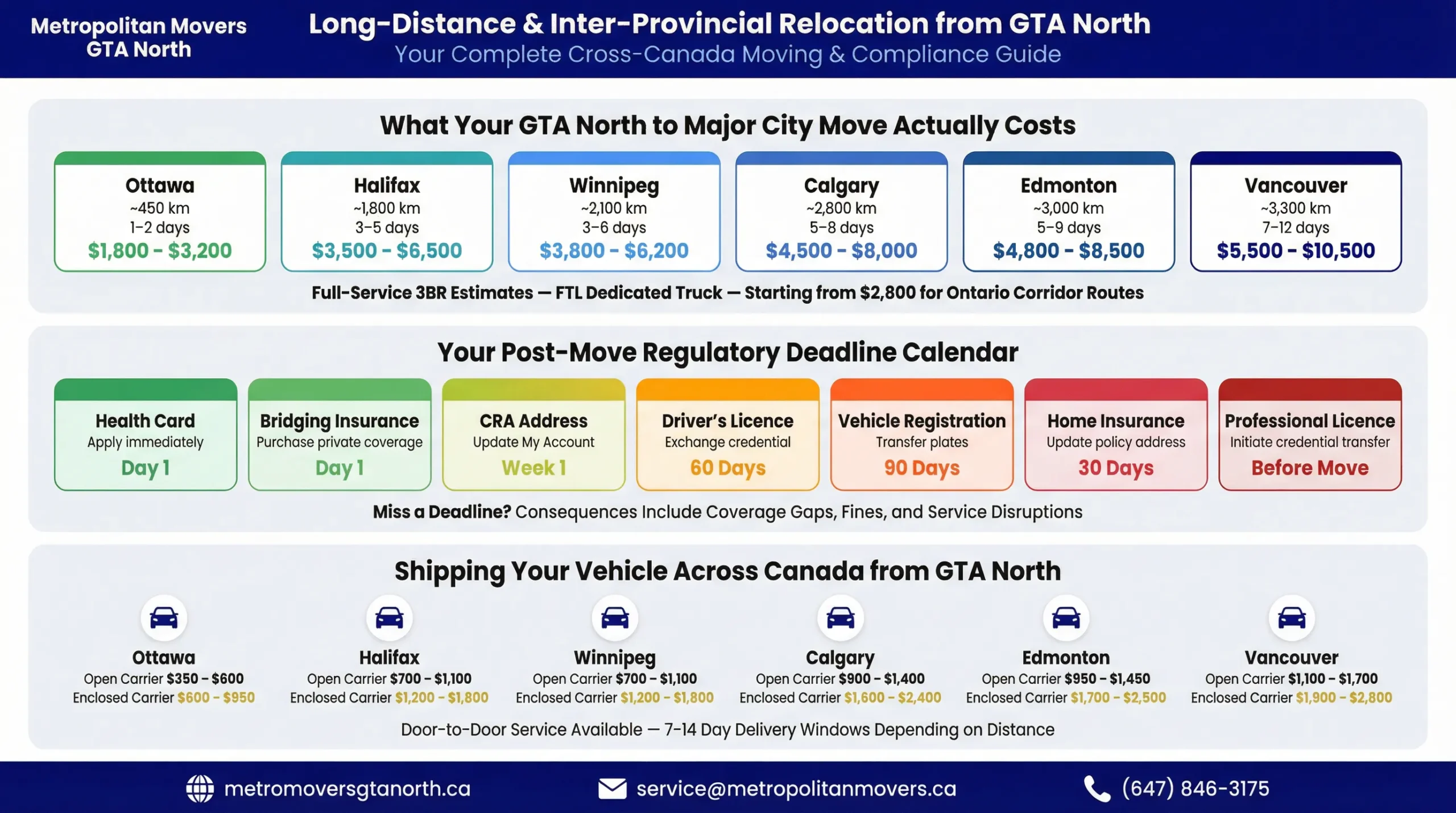
| Newmarket / Aurora | Ottawa, ON | ~450 km | 1–2 days | $1,800 – $3,200 |
| Markham / Richmond Hill | Montreal, QC | ~540 km | 1–2 days | $2,200 – $3,800 |
| Vaughan / Newmarket | Halifax, NS | ~1,800 km | 3–5 days | $3,500 – $6,500 |
| Richmond Hill / Vaughan | Winnipeg, MB | ~2,100 km | 3–6 days | $3,800 – $6,200 |
| Aurora / Markham | Calgary, AB | ~2,800 km | 5–8 days | $4,500 – $8,000 |
| Richmond Hill / Newmarket | Edmonton, AB | ~3,000 km | 5–9 days | $4,800 – $8,500 |
| GTA North (all communities) | Vancouver, BC | ~3,300 km | 7–12 days | $5,500 – $10,500 |
| Estimates reflect standard 3BR full-service moves | Actual quotes vary by shipment weight, access conditions, and seasonal demand | metromoversgtanorth.ca | ||||
Variables That Push Your Cost Above the Base Range:
- Stair carry or long-carry requirements at either origin or destination address
- Specialty items requiring dedicated handling: pianos, safes, gym equipment, pool tables
- Delivery to a remote or rural postal code in the destination province
- Seasonal surcharges during peak demand (May through September and month-end dates)
- Storage-in-transit requirements when destination property possession is delayed
- Full-service packing at origin versus self-pack models
For a written estimate calibrated to your actual shipment volume and destination, long-distance moving connects you directly with the planning team.
Moving from GTA North to Calgary and Edmonton: The Ontario-to-Alberta Corridor
The Ontario-to-Alberta corridor is one of the highest-volume long-distance and inter-provincial relocation routes in Canada. Employment opportunities in Alberta’s energy, technology, and construction sectors, combined with a significantly lower cost of living relative to GTA North, drive consistent westward migration from York Region every year.
The Financial Case for Relocating from Ontario to Alberta:
Alberta operates without a provincial sales tax. Ontario residents pay 13% HST on most goods and services; Alberta residents pay only the federal 5% GST. Over the course of a year, the absence of provincial sales tax accumulates to thousands of dollars in retained household income — particularly for families making major purchases in the first year at a new address. Housing purchase prices in Calgary and Edmonton run substantially below comparable GTA North properties, and property tax rates in Alberta’s major cities are generally lower than those in York Region municipalities. These financial advantages are structural and ongoing, not temporary.
Tax Residency When Moving Mid-Year from Ontario to Alberta: When you relocate from Ontario to Alberta partway through a calendar year, your provincial tax filing position is determined by your province of residence on December 31st of that year. If you move to Alberta in July and reside there on December 31st, you file your provincial taxes as an Alberta resident for that full tax year — even though you lived in Ontario for the first six months. This means you benefit from Alberta’s lower provincial tax rate for the entire year of your move, but it also means you lose access to Ontario-specific credits and benefit calculations for that year. Any mid-year move should involve a conversation with a tax professional before the move date to optimize your filing position.
Driver’s Licence and Vehicle Registration in Alberta: Once you establish residency in Alberta, you have 90 days to exchange your Ontario driver’s licence for an Alberta licence. The exchange is direct — no testing is required for holders of a valid full Ontario licence in good standing. Vehicle registration must transfer to Alberta within the same 90-day window. Driving an Ontario-plated and Ontario-registered vehicle in Alberta beyond this window creates insurance coverage risk, as your auto insurance policy requires your province of residence to be accurately recorded.
Logistics Planning for the Ontario-to-Alberta Distance: At approximately 2,800 to 3,000 kilometres depending on your specific GTA North origin point and Alberta destination city, the Ontario-to-Alberta shipment operates on a five-to-nine business day transit window under standard conditions. Summer moves benefit from reliable prairie highway conditions. Winter moves — November through March — must account for potential Highway 1 delays through northern Ontario and winter storm closures on Trans-Canada sections through Manitoba and Saskatchewan. Any long-distance shipment planned for this corridor between December and February should include a weather contingency buffer of two to three additional transit days.
For Richmond Hill-origin long-distance planning, moving from Richmond Hill to Cornwall demonstrates the eastern Ontario route framework that scales operationally to the full Alberta corridor.
Moving from Markham to Halifax: The Eastern Canada Relocation Route
The Markham-to-Halifax corridor covers approximately 1,800 kilometres by the Trans-Canada Highway routing through Quebec, New Brunswick, and Nova Scotia. Halifax and the broader Nova Scotia market have attracted significant GTA North migration in recent years, driven by lower property costs, a growing technology sector, and quality-of-life factors that appeal particularly to families and professionals entering their mid-career years.
Route and Transit Reality for the Markham–Halifax Corridor: The standard routing follows Highway 401 east through Kingston to the Quebec border, continues east through Montreal on Highway 40, and transitions to Trans-Canada Highway 1 through New Brunswick into Nova Scotia. Standard transit time for a full household shipment on this route runs three to five business days under normal conditions. The New Brunswick segment — particularly the Trans-Canada between Fredericton and Moncton — is subject to severe winter weather from November through early April, and ice storm events on this section regularly close the highway or reduce it to one lane under escort. Any Markham-to-Halifax move planned between November and March should build in a two-day weather buffer and confirm road conditions the day before the truck departs.
Halifax Urban Delivery Constraints: Halifax’s older residential neighbourhoods — the North End, South End, and West End — feature narrow streets that limit large moving truck access. Parking permits for moving vehicles in Halifax require advance application through Halifax Regional Municipality, and several streets have size restrictions that apply regardless of permit. When booking a Markham-to-Halifax long-distance move, confirm street access and parking permit requirements at the destination address before the loading date.
Nova Scotia’s Housing Market Expectations for GTA North Buyers: GTA North buyers entering the Halifax market frequently arrive with price expectations calibrated to the pre-2020 Nova Scotia market. That market no longer exists. Halifax has experienced significant price appreciation since 2020, and buyers who last researched the market six or twelve months ago should re-verify current pricing before making financial commitments based on outdated data.
For Markham-origin planning references, moving from Markham to Brockville illustrates the eastern Ontario corridor framework that applies across all Maritime destination routes.
Moving from Newmarket to Ottawa: Ontario’s Most Efficient Long-Distance Corridor
The Newmarket-to-Ottawa corridor sits at approximately 450 kilometres and occupies a unique position in GTA North long-distance planning: it is fully within Ontario, covers a manageable highway distance, and can execute as a single-day operation with an early departure from York Region.
Why This Route Requires More Planning Than the Distance Suggests:
Despite its relatively compact distance, the Newmarket-to-Ottawa move carries specific logistical variables that distinguish it from a straightforward extended local move.
Ottawa’s Parking Permit Requirements: Moving trucks parked on Ottawa residential streets require a temporary no-parking permit issued by the City of Ottawa. Most residential streets in Ottawa’s urban neighbourhoods — particularly Centretown, Glebe, Westboro, and Hintonburg — enforce this requirement actively. Permits require submission at least 48 to 72 hours before the parking date. Arriving without a permit on a street with active enforcement creates a tow risk that would be far more expensive than the cost of advance permit processing.
Highway 417 Congestion Window: The 417 approaching downtown Ottawa from the west carries significant congestion during morning and late-afternoon commuter windows. A Newmarket departure of 5:00 to 6:00 a.m. positions the truck to reach the 417 before peak traffic builds and completes Ottawa delivery during the mid-morning off-peak window. Departing at 8:00 a.m. or later adds unpredictable delay to the Ottawa approach.
Winter Routing Decision: Highway 7 through the Madawaska Valley is the scenic routing from GTA North to Ottawa but becomes hazardous in winter conditions. The correct winter routing follows Highway 401 east to Highway 416 north to Highway 417 west — longer in kilometres but maintained more reliably by the Ministry of Transportation through winter storm events.
For Newmarket-origin long-distance planning, moving from Newmarket to Belleville demonstrates the eastern Ontario highway planning approach that applies to the full Ottawa corridor.
Shipping a Car Across Canada from GTA North: The Complete Vehicle Transport Framework
Moving cross-country from GTA North frequently involves more vehicles than one person can drive. Families with multiple cars, seniors who prefer not to drive long distances, and households making a one-way relocation all face the same question: how do you get your vehicle to the destination without adding thousands of kilometres of highway driving to an already complex relocation?
Auto Transport Options Available from GTA North:
Open Carrier Transport: Open carrier transport is the standard and most cost-accessible vehicle shipping option. Your vehicle loads onto an open multi-car carrier alongside other vehicles and transports directly to the destination city. Open carriers are appropriate for standard passenger vehicles, minivans, SUVs, and pickup trucks. The carrier is open to road debris and weather conditions during transit — a practical non-issue for daily-use vehicles but a relevant consideration for collector and high-value cars.
Enclosed Carrier Transport: Enclosed carrier transport provides full weather and debris protection. Your vehicle travels inside a closed carrier, insulated from road conditions throughout the full cross-Canada transit. Enclosed carriers cost 40 to 60 percent more than open carriers but deliver the protection standard that collector vehicles, luxury cars, low-clearance sports cars, and newly purchased vehicles require. For any vehicle where cosmetic condition matters significantly, enclosed carrier is the correct choice.
Terminal-to-Terminal vs. Door-to-Door Delivery: Terminal-to-terminal shipping requires you to drop your vehicle at a designated transport terminal in GTA North and collect it at a terminal in the destination city. It reduces the per-vehicle cost but adds logistical inconvenience — particularly at the destination end, where you may arrive in an unfamiliar city without your own transportation before the terminal opens. Door-to-door service picks your vehicle up at your current GTA North address and delivers it to your new address, eliminating terminal logistics on both ends. For most GTA North residential clients, door-to-door is the operationally cleaner choice.
Vehicle Shipping Cost Ranges from GTA North:
| Destination City | Open Carrier Estimate | Enclosed Carrier Estimate | Estimated Delivery Window |
|---|---|---|---|
| Ottawa, ON | $350 – $600 | $600 – $950 | 2–4 days |
| Halifax, NS | $700 – $1,100 | $1,200 – $1,800 | 4–7 days |
| Calgary, AB | $900 – $1,400 | $1,600 – $2,400 | 7–10 days |
| Edmonton, AB | $950 – $1,450 | $1,700 – $2,500 | 7–11 days |
| Vancouver, BC | $1,100 – $1,700 | $1,900 – $2,800 | 10–14 days |
| Winnipeg, MB | $700 – $1,100 | $1,200 – $1,800 | 5–8 days |
| Vehicle shipping estimates from GTA North | Rates vary by vehicle type, season, and carrier availability | metromoversgtanorth.ca | |||
What to Prepare Before Your Vehicle Ships:
- Remove every personal item from the vehicle interior, trunk, and cargo area — auto transport operators do not cover personal goods inside vehicles, and many will refuse to load a vehicle with personal items inside
- Photograph the vehicle’s full exterior from every angle with time-stamped photos before the carrier arrives — these photos are your reference baseline for any damage claim at delivery
- Reduce the fuel level to approximately one-quarter tank — transport operators apply this as a weight and safety standard
- Confirm the carrier’s per-vehicle cargo liability insurance coverage in writing before the vehicle loads — legitimate operators provide a minimum of $100,000 cargo coverage per vehicle
Inter-Provincial Relocation Regulations Every GTA North Resident Must Navigate
Long-distance and inter-provincial relocation from GTA North triggers a set of statutory compliance obligations in both the origin and destination provinces. These are not optional administrative tasks — they carry legal deadlines, and several carry financial consequences for non-compliance.
The Health Care Coverage Gap: Ontario to Any Province This is the most financially dangerous regulatory gap in any inter-provincial relocation. Every Canadian province operates its own health insurance plan, and each province enforces a waiting period before new resident coverage activates. Depending on the destination province, this waiting period runs up to three months from your arrival date. During this window, your Ontario OHIP coverage provides limited bridge protection — but that bridge has an expiry that aligns with the end of your Ontario residency, not the start of your new provincial coverage.
The correct response is to purchase private bridging health insurance on the day you establish residency in the new province. Not as a contingency if something goes wrong — as a standard part of your relocation financial plan. Apply for your new provincial health card on arrival day to start the waiting period clock immediately.
Driver’s Licence Transfer Deadlines Across Provinces: Every Canadian province sets its own deadline for out-of-province licence exchange. Most provinces allow between 60 and 90 days from the date of residency establishment before requiring a valid in-province licence. The exchange process for holders of a valid full Canadian licence in good standing is a direct credential swap in virtually all cases — no road test, no written test. The licence exchange triggers your auto insurance provider notification requirement simultaneously.
Vehicle Registration Provincial Transfer: Your Ontario vehicle registration does not remain valid indefinitely after you establish residency in another province. Most provinces require vehicle re-registration within 90 days of residency establishment. Driving a vehicle with an out-of-province registration beyond the deadline creates an insurance coverage risk — your policy requires accurate residency information, and a mismatch between your recorded province of residence and the registered province can create grounds for coverage denial.
Professional Credentials and Inter-Provincial Licence Portability: Canada’s Agreement on Internal Trade and the Canadian Free Trade Agreement establish labour mobility frameworks that reduce — but do not eliminate — the administrative barriers to practising a regulated profession in a new province. If you hold a regulated licence as a physician, nurse, lawyer, engineer, electrician, plumber, or other credentialed professional, you must initiate the credential transfer process with the destination province’s regulatory body before your move date, not after arrival. Transfer timelines vary by profession and province — some complete within two to four weeks, others require several months. Starting this process early ensures no gap in your ability to work in your regulated field.
Firearm Transport Across Provincial Borders: Moving legally owned firearms between provinces in Canada requires compliance with federal legislation. All firearms must be unloaded during transport. Non-restricted firearms must be locked in a secure container. Restricted firearms require an Authorization to Transport (ATT) in addition to your valid Possession and Acquisition Licence (PAL). Moving your primary residence between provinces triggers a notification obligation to the Chief Firearms Officer in both the origin and destination provinces. Consult the Canadian Firearms Program for the complete compliance checklist before packing any firearms for transport.
Alcohol Transport Rules Between Provinces: Each Canadian province regulates the quantities of alcohol that individuals may transport across its borders for personal use. Quantities that are legal in Ontario may exceed the import limit in certain Maritime or western provinces. Transporting alcohol quantities above a province’s personal import limit creates an inspection delay risk at border checkpoints and potential fine exposure. Verify the destination province’s alcohol import limits before packing any wine, spirits, or beer for your long-distance move.
Canada Revenue Agency Address Update: Updating your address with the CRA is both an administrative necessity and a financial protection measure. CRA uses your registered address for: tax correspondence, GST/HST credit payments, Canada Child Benefit payments, TFSA and RRSP documentation, and Notices of Assessment. A CRA address that does not reflect your current province of residence creates risk of delayed benefit payments and misdirected correspondence. Update your CRA address at canada.ca/my-cra-account on or before your move date.
Long-Distance Furniture Shipping: Full Truckload vs. Consolidated Load — Choosing the Right Model
Not every long-distance and inter-provincial relocation from GTA North involves a full household shipment. Estate shipments, phased relocations where furniture moves ahead of the family, and small apartment moves all generate partial-volume shipping requirements that a dedicated full truckload does not serve cost-effectively.
Full Truckload (FTL): The Dedicated Shipment Model Your goods occupy an entire truck from GTA North origin to destination. No consolidation with other customers’ shipments. No intermediate loading or unloading stops. The FTL model delivers the fastest transit time and eliminates the handling risk that comes with consolidation. For any household shipment above approximately 600 cubic feet of volume — typically a two-bedroom home or larger — FTL almost always delivers better value per cubic foot than LTL once the total shipment size is calculated.
Less Than Truckload (LTL): The Consolidated Load Model Your shipment shares truck space with other customers’ goods moving on a similar route. LTL pricing is lower in absolute dollar terms but introduces two operational variables: transit time extends because the carrier makes loading and unloading stops for other shipments along the route, and each additional handling event carries incremental damage risk for your goods. LTL is cost-appropriate for studio apartment moves, single-room shipments, and standalone furniture items that need to reach a destination without a full truck rental.
Factors That Directly Affect Your Long-Distance Furniture Shipping Rate:
- Total cubic footage or weight of the shipment
- Declared replacement value of goods (higher declared value increases cargo insurance cost)
- Destination accessibility — urban core delivery in Vancouver or downtown Calgary versus suburban delivery carries different access cost implications
- Stair carry or long-carry charges at origin and destination
- Whether packing services are included or the client self-packs
- Delivery timeline flexibility — a guaranteed delivery date on LTL costs more than a flexible delivery window
Driving from Ontario to BC: Route Planning, Seasonal Safety, and Best Stops
For GTA North residents who choose to drive cross-country rather than fly, the Ontario-to-BC drive is one of the most memorable road experiences in Canada and one of its most technically demanding. The Trans-Canada Highway from GTA North to Vancouver covers approximately 4,400 road kilometres and crosses five provinces.
Day-by-Day Driving Plan from GTA North to Vancouver:
Day One — GTA North to Sudbury or Sault Ste. Marie (400–700 km): Exit GTA North via Highway 400 north, continuing to Highway 69 and onward to Highway 17 west. The northern Ontario section of this route is scenic but carries limited fuel and service availability between major towns. Fill up at every opportunity — fuel gaps on Highway 17 between Sudbury and Sault Ste. Marie extend further than most drivers from York Region expect.
Day Two — Sault Ste. Marie to Winnipeg (~1,300 km combined from Toronto): The Trans-Canada from Sault Ste. Marie through Thunder Bay and into Manitoba follows Lake Superior’s northern shore — one of the most visually striking sections of the entire cross-country route. Winnipeg serves as the natural overnight stop at approximately 2,100 kilometres from GTA North. The city’s Exchange District and The Forks areas provide accessible accommodation and dining options near the Trans-Canada approach.
Day Three — Winnipeg to Regina or Moose Jaw (~600 km): The Saskatchewan prairies open on Day Three with flat terrain and minimal traffic, making this the easiest driving day of the route. Moose Jaw, just west of Regina, positions you favourably for Day Four’s Alberta entry.
Day Four — Moose Jaw to Medicine Hat or Lethbridge (~500 km): Entering Alberta, the terrain begins its gradual shift toward the foothills. Medicine Hat and Lethbridge both offer efficient fuel and accommodation options. Lethbridge positions you for a morning entry into Calgary or a direct northwest routing toward Banff and the mountain passes.
Day Five — Calgary to Revelstoke, BC (~600 km): The Trans-Canada from Calgary through Banff National Park, over Kicking Horse Pass, and into British Columbia is the most technically demanding driving section of the route. The Rogers Pass section between Revelstoke and Golden carries avalanche control closures from November through April — check DriveBC road conditions and Alberta 511 before this section regardless of season.
Day Six — Revelstoke to Vancouver (~650 km): Two routing options exist from Revelstoke to Vancouver. The Coquihalla Highway (Highway 5) from Kamloops to Hope is the fastest — well-maintained, high-speed, and direct. Highway 1 through the Fraser Canyon from Cache Creek to Hope is longer but passes through the dramatically scenic Fraser River gorge. Either route delivers you into Greater Vancouver via Highway 1 through the Fraser Valley.
Winter Mountain Pass Rules for BC: British Columbia’s Commercial Vehicle Safety and Enforcement regulations require winter tires on passenger vehicles travelling mountain highway routes — including the Coquihalla, Trans-Canada through Rogers Pass, and Highway 3 through Allison Pass — between October 1 and April 30. Carry chains regardless of tire specification if your crossing dates fall in the November-to-March window. Mountain pass conditions can deteriorate from clear to closed within two to three hours of an incoming weather system.
The Complete Post-Move Administrative Checklist for Ontario Residents Relocating Across Provinces
The administrative phase of a long-distance and inter-provincial relocation is as operationally demanding as the physical move. Every item on this checklist carries a deadline, and several carry financial or legal consequences for non-completion.
| Relocation Phase | Required Action | Statutory Deadline | Authority / Resource |
|---|---|---|---|
| 8–12 Weeks Before Move | Book long-distance mover; get written binding estimate; arrange vehicle transport | As early as possible — peak season books 8–12 weeks out | metromoversgtanorth.ca/contact |
| 4–6 Weeks Before Move | Notify CRA of address change; redirect Canada Post; research destination health card application | Before move date | canada.ca/my-cra-account; canadapost.ca |
| Arrival Day | Apply for new provincial health card; purchase bridging private health insurance; confirm utility connections active | Day 1 — waiting period clock starts on arrival date | Destination province health ministry |
| Within 30 Days | Notify all financial institutions; update home insurance; update employer HR payroll records; update school registrations | Within 30 days of arrival | Your bank, insurer, and employer HR department |
| Within 60 Days | Exchange driver’s licence for destination province licence; notify auto insurance of province change | 60 days (most provinces); verify destination province’s specific deadline | Destination province licensing office; your auto insurer |
| Within 90 Days | Transfer vehicle registration to destination province; initiate professional credential transfer if applicable | 90 days from residency establishment | Destination province vehicle registry |
| April 30 — Tax Year | File provincial taxes as resident of province where you lived on December 31st of the move year | Standard annual tax filing deadline | canada.ca/my-cra-account |
| Inter-provincial compliance timeline for GTA North residents | All deadlines subject to destination province variation | metromoversgtanorth.ca | |||
How Metropolitan Movers GTA North Structures Every Long-Distance Shipment for Consistent Delivery
The operational model that Metropolitan Movers GTA North applies to long-distance and inter-provincial relocation jobs differs from local move execution across every dimension: planning depth, crew assignment, vehicle selection, transit tracking, storage integration, and destination-end coordination.
Written Assessment Before Any Booking Confirms: Every long-distance job from GTA North starts with a detailed written assessment — not a phone estimate. The assessment captures: total shipment volume, specialty item inventory, origin access variables, destination access constraints, transit timeline, and the optimal service model (FTL vs. LTL, full-service vs. partial-service). This assessment drives every downstream operational decision and produces the binding written estimate that protects the client’s cost position throughout the job.
The Same Crew Loads and Unloads Your Shipment: One of the primary risk factors in long-distance moving is the handoff — when the crew that loaded your goods in GTA North transfers the shipment to a different team at an intermediate depot for the final delivery leg. This handoff is where most long-distance damage events occur. Metropolitan Movers GTA North assigns a dedicated crew that travels with your shipment from GTA North loading to destination unloading. The same hands that packed and loaded your belongings place them in your new property.
Real-Time Shipment Tracking: Every long-distance shipment moves under GPS-tracked transport. Clients receive a direct contact line for the crew lead throughout the transit window. Delivery ETA updates are proactive — not reactive responses to client inquiries. If a weather event, road closure, or routing change affects the delivery window, the client hears about it from the crew, not from a tracking app.
Storage-in-Transit Integration: When the destination property is not available on the planned delivery date — a routine occurrence in inter-provincial moves where closing dates and moving timelines operate on independent schedules — the storage and moving service integration holds the shipment under secure storage without requiring a second crew mobilization or second truck repositioning cost.
Destination Setup Completes the Service: The long-distance service delivery does not end when the last box enters the new property. All furniture is placed in designated rooms, reassembled, and confirmed by the client through a room-by-room walkthrough with the crew lead. All packing materials are removed. The client’s new property is functional — not just full of boxes — when the crew departs.
For specific GTA North origin routes, dedicated long-distance planning resources cover:
- Moving from Newmarket to Belleville
- Moving from Markham to Brockville
- Richmond Hill to Windsor
- North York to Ottawa
- Markham to London Ontario
- King City to Peterborough
For a full written assessment and binding estimate on your specific long-distance or inter-provincial move, connect with the planning team at the contact page.
Frequently Asked Questions — Long-Distance & Inter-Provincial Relocation from GTA North
How far in advance should I book a long-distance mover from GTA North?
For moves scheduled between May and September — the peak demand window for long-distance and inter-provincial relocation from GTA North — booking eight to twelve weeks in advance is the correct planning horizon. Dedicated FTL truck availability on cross-Canada routes tightens significantly during this period, and York Region’s end-of-month closing date concentration creates additional booking pressure on specific calendar dates. Off-peak moves between October and April can typically be arranged with four to six weeks of lead time, though earlier booking consistently delivers better schedule flexibility and, in some cases, more competitive pricing on the overall job.
Does my Ontario home insurance cover my belongings during a long-distance move?
Most Ontario home insurance policies extend some level of contents coverage to belongings in transit, but with material limitations that create meaningful gaps. Common exclusions include: items in self-packed boxes where the cause of damage is disputed, single items above the policy’s per-item sub-limit, and items stored at an interim facility during a transit gap. The correct approach is to request written confirmation from your insurance broker of exactly what your policy covers during a move in transit before loading day. For shipments where the replacement value of contents exceeds your home policy’s coverage ceiling, supplemental cargo insurance through the moving company covers the declared value of the full shipment.
What is the difference between a binding and non-binding estimate on a long-distance move?
A binding written estimate fixes the total price you will pay regardless of whether the actual measured shipment weight or volume differs slightly from the pre-move estimate. A non-binding estimate is subject to revision based on the actual weight of your shipment after loading at origin — which means your final invoice can exceed the quoted figure if the crew measures more volume than anticipated. For long-distance and inter-provincial relocation, a binding written estimate is the stronger consumer protection position. Always request binding written estimates from any long-distance carrier operating from GTA North, and confirm in writing what happens if additional items are added to the shipment after the estimate is signed.
Can I pack my own boxes for a long-distance move, and what does it mean for my damage coverage?
Self-packing is permitted and reduces your overall move cost by eliminating the labour component of origin packing. The cargo insurance implication is important: most long-distance cargo policies cover damage attributable to carrier handling but exclude damage to self-packed boxes where the cause of damage cannot be established as a carrier handling event. If a self-packed box arrives damaged, the default carrier position is that the packing methodology — not handling — caused the damage. For fragile, high-value, or irreplaceable items, professional packing by the moving crew transfers the damage liability to the carrier and provides full cargo insurance coverage. The packing and unpacking service team handles all item categories with appropriate materials for full coverage protection.
What happens to my belongings if my destination property is not ready on the planned delivery date?
Closing date delays, renovation overruns, and lease start date mismatches are among the most common complications in inter-provincial relocation — particularly when the destination property is in a different province and your ability to monitor the situation in person is limited. The correct solution is pre-arranged storage-in-transit, where your shipment moves to secure storage near the destination at an agreed rate until your property is ready for delivery. Booking this contingency before the move begins — when you have full negotiating position — produces substantially better pricing and operational flexibility than arranging emergency storage after a delay is confirmed in an unfamiliar city. Storage and moving services cover both the transit and storage phases under a single operational framework.
Do I need to notify my auto insurance provider when I move to another province?
Yes — and the notification is time-sensitive with real financial consequences for delay. Auto insurance in Canada is provincially regulated, and your Ontario auto insurance policy does not automatically extend to a change of province of residence. Your insurer must be notified of the province change, and you will typically need to obtain new insurance coverage in the destination province within 30 to 60 days of establishing residency. Operating a vehicle in a new province under an Ontario policy after the notification deadline creates a coverage void — meaning you bear personal financial liability for any accident during the non-compliant window. Contact your broker on or before your move date to initiate the provincial insurance transfer.
Is there a financial tax advantage to relocating from Ontario to Alberta specifically?
The financial advantage of relocating from Ontario to Alberta is structural and compounding over time. Alberta operates without a provincial sales tax, meaning residents pay only the 5% federal GST on most goods and services rather than Ontario’s 13% HST. This difference accumulates significantly across a year of normal household and vehicle spending. Provincial income tax rates in Alberta are also structured differently from Ontario’s, and the specific benefit to your household depends on your income level, family structure, and deduction profile. If you relocate mid-year — moving to Alberta in, say, July — your provincial tax filing for that year is based on your province of residence on December 31st. A tax professional consultation before the move date helps you understand the full-year tax picture and optimize your filing position for the year of the move.
What regulated items cannot be transported by a moving company across provincial borders?
Inter-provincial moving carriers cannot legally transport: hazardous materials including flammable liquids, compressed gases, and explosive materials; firearms without the client’s valid PAL and ATT documentation confirmed before loading; quantities of alcohol that exceed the destination province’s personal import limits; and live plants subject to the destination province’s agricultural inspection and quarantine restrictions. Some provinces also restrict the transport of certain produce categories under plant health regulations administered by the Canadian Food Inspection Agency. Disclose all potentially regulated items during your pre-move written assessment — before loading day — to allow the planning team to advise on compliant handling or alternative transport arrangements.
How does the FTL versus LTL model affect my overall long-distance moving budget?
FTL costs more in absolute dollar terms because you pay for an entire truck and crew from origin to destination regardless of whether your shipment fills the truck completely. LTL costs less per cubic foot but introduces transit time variability and incremental handling risk from consolidation stops. For most GTA North households relocating a two-bedroom home or larger over long distances, FTL delivers better total value per dollar when you factor in: faster transit time, lower handling risk, single-crew accountability, and the elimination of intermediate depot handoffs. The crossover point where LTL becomes more cost-effective than FTL generally sits below 400 to 600 cubic feet of total shipment volume. The long-distance moving planning team calculates the optimal model for your specific shipment volume and destination at the written assessment stage.
What should I look for in a long-distance mover to avoid scams and hidden charges on cross-Canada moves?
Three verification steps protect GTA North residents from fraudulent long-distance operators. First, confirm the company holds a valid federal transport licence — inter-provincial carriers must be licensed under federal transportation regulations, and the operator should produce this documentation on request without hesitation. Second, require a written binding estimate before signing any agreement — a legitimate long-distance operator provides a binding written estimate, not a verbal quote subject to unlimited revision at delivery. Third, verify the company’s WSIB clearance independently through wsib.ca before handing over a deposit — an operator who cannot provide WSIB documentation is not operating a legitimate business. Any mover who demands full cash payment before delivery, cannot provide a physical business address, or refuses to put the estimate in writing is exhibiting the same red flags that identify fraudulent local operators at the long-distance level.