
You found the perfect Aurora listing and ran a quick affordability check based on rent or mortgage alone. Three months after moving in, the reality hits — property taxes doubled what you expected, commuting eats $600 monthly, and grocery bills exceed downtown Toronto prices somehow. Understanding the true Aurora Ontario cost of living before signing anything prevents these expensive surprises that force families to relocate again within 18 months.
Metropolitan Movers GTA North helps families budget Aurora moves realistically every week. We watch newcomers underestimate the full monthly expense by 30-40% because they focus exclusively on housing while ignoring the seven other categories that determine whether Aurora fits your actual financial capacity. This guide breaks down every significant cost using current 2026 data so your budget reflects reality, not wishful thinking. For context across the broader region, our GTA North neighbourhood luxury living guide positions Aurora against Newmarket, Richmond Hill, and Vaughan alternatives.
Complete Monthly Budget Breakdown for Aurora Families
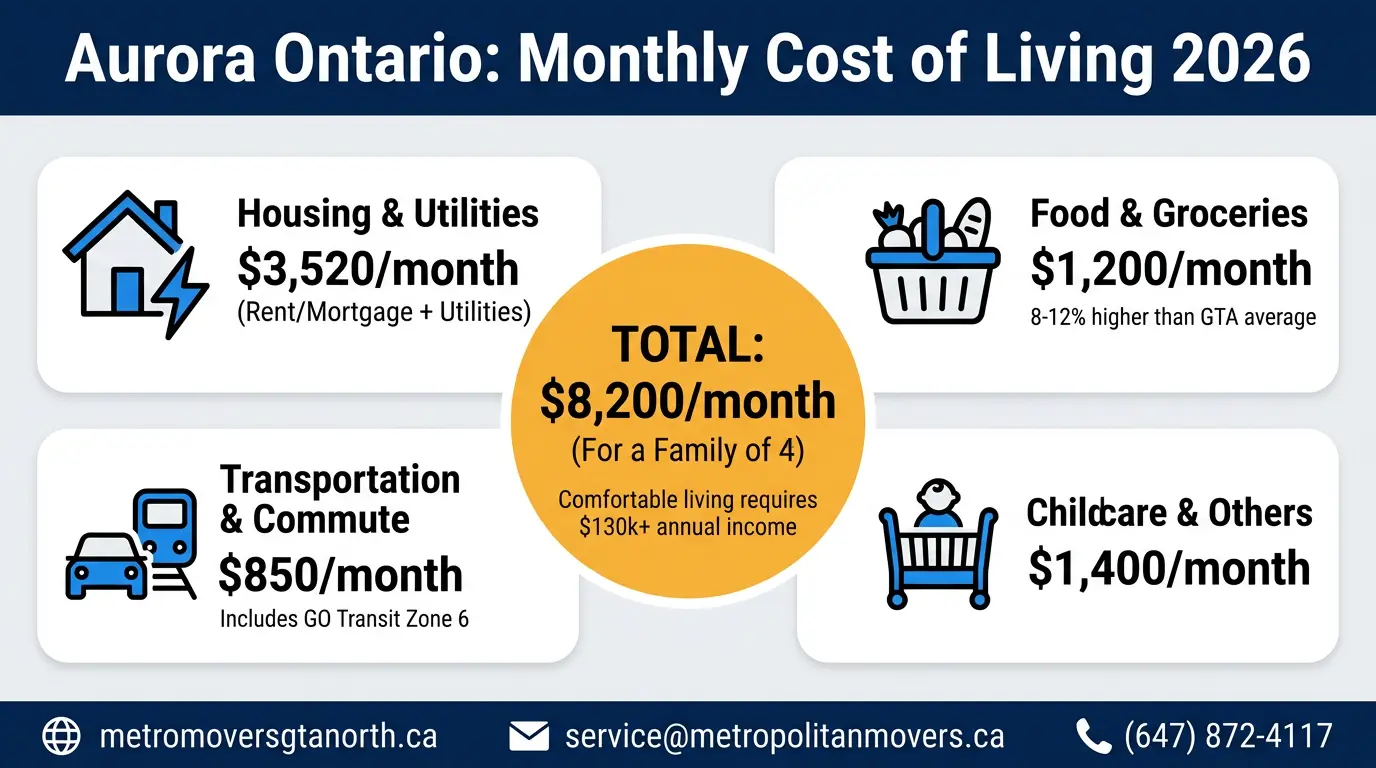
The Aurora Ontario cost of living requires household income of approximately $55,000 for singles, $80,000 for couples, and $130,000 for families of four to live comfortably while building savings. These numbers assume renting — homeownership pushes required income 25-35% higher depending on down payment and mortgage rates.
Average Monthly Rent in Aurora Ontario: Current Market Reality
Aurora’s rental market splits into two distinct tiers. Purpose-built apartments along Yonge Street and Wellington Street East rent bachelor units from $1,650-$1,900, one-bedrooms from $1,850-$2,200, and two-bedrooms from $2,350-$2,750. Basement apartments in detached homes command $1,600-$2,000 for one-bedroom setups and $2,100-$2,500 for two-bedroom legal units.
Aurora sits between the two neighbouring markets — more expensive than Newmarket but cheaper than Richmond Hill. For families seeking York Region quality of life with slightly better rental value, moving to Newmarket merits comparison. Our GTA North neighbourhood luxury living guide maps exact value positioning across every community.
Property Tax Rates and Homeownership Costs
York Region’s 2026 combined property tax rate (regional, municipal, and education portions) for Aurora averages approximately 0.71% of assessed property value. On a $1.2 million detached home, expect annual property taxes near $8,520 or roughly $710 monthly. This rate sits competitively against Toronto’s 0.67% but notably higher than Vaughan’s 0.598%.
Beyond property tax, Aurora homeowners face several additional monthly costs often underestimated during the buying process. Home insurance averages $150-$220 monthly depending on home value and coverage limits. Utilities including electricity, natural gas, water, and waste removal total $280-$350 monthly for typical detached homes. Maintenance reserves should budget $200-$300 monthly for the inevitable roof, furnace, and appliance replacements that homeownership demands.
The complete Aurora Ontario cost of living for homeowners includes these often-forgotten expenses. A $1.2M home with 20% down at current rates generates approximately $4,800 monthly in mortgage, property tax, insurance, and utilities before groceries or transportation enter the equation.
Grocery and Daily Living Expenses in Aurora
Aurora’s grocery landscape centers on Yonge Street corridor retailers including Metro, Loblaws, and independent stores. Prices track slightly above GTA average — expect to pay 8-12% more than Walmart or No Frills locations in Newmarket or Vaughan. A family of four spending $1,100-$1,300 monthly on groceries represents realistic budgeting for standard meal planning without extreme couponing.
Dining out in Aurora reflects its small-town character with independent restaurants rather than chain dominance. Casual family dinners average $80-$110 for four people. Coffee shops, bakeries, and specialty food retailers cluster along Wellington Street, supporting local business at premium pricing compared to big-box alternatives.
Utility costs deserve specific attention in the Aurora Ontario cost of living calculation. Alectra Utilities serves Aurora with electricity rates following Ontario Energy Board structures. Natural gas through Enbridge runs higher in Aurora than urban centres due to infrastructure distribution costs. Combined monthly utility bills of $280-$350 for detached homes reflect this reality.
Transportation and Commuting: The Hidden Budget Killer
Aurora remains fundamentally car-dependent despite GO Transit access. The Aurora GO Station on the Barrie line connects to Toronto’s Union Station in 55-70 minutes depending on express versus local service. Monthly GO passes cost $387.75 for Zone 6, but parking at the station adds $125-$150 monthly unless you live within walking distance.
For families relying entirely on vehicles, Aurora’s cost of living includes significant transportation expenses. Two-car households budget $650-$900 monthly covering fuel, insurance, maintenance, and payments. York Region Transit offers local bus service, but Aurora’s sprawl makes car-free living impractical for most families with children.
Downtown Toronto commuters face the calculation — is $515 monthly for GO Transit plus parking cheaper than driving and paying downtown parking rates of $400-$600 monthly? The break-even point favours GO Transit while also recovering 60-90 minutes daily for reading, working, or simply not white-knuckling Highway 404 traffic.
Affordable Aurora Neighborhoods for Families
Budget-conscious families exploring the Aurora Ontario cost of living should focus on specific neighbourhoods offering better entry points. The Wellington Street East corridor provides older housing stock from the 1980s-1990s at $900,000-$1.1M for detached homes versus $1.3M-$1.6M in newer developments near St. Andrew’s College.
Industrial Parkway South neighbourhoods offer townhomes from $750,000-$900,000 — genuine value in York Region context. These areas trade newer construction and premium school catchments for functional family housing within reach of moderate dual incomes. Basement apartment opportunities here provide rental income offsetting mortgage costs if permitted by zoning.
Northern Aurora near Bloomington Road represents Aurora’s growth frontier. New subdivisions price from $1.1M-$1.4M for detached homes with larger lots than southern neighbourhoods but pushing commute times another 10-15 minutes. Families prioritizing space over convenience find value here.
Making Aurora Work For Your Budget
The Aurora Ontario cost of living demands household income of $130,000+ for families purchasing detached homes comfortably while maintaining savings and retirement contributions. Renters need $80,000-$90,000 household income for two-bedroom apartments without financial stress. Singles require $55,000-$65,000 for one-bedroom units with modest lifestyle spending.
Metropolitan Movers GTA North handles Aurora relocations regularly and understands the financial realities newcomers face. Our local moving service covers Aurora alongside Newmarket, Richmond Hill, and the broader York Region with crews who know building restrictions and HOA requirements.
For families arriving from other provinces, our long-distance moving service coordinates everything from origin to Aurora address. Piano or specialty items require dedicated handling — our piano moving Aurora and Aurora packing moving teams protect high-value belongings with precision.
Aurora delivers York Region quality of life at moderate premiums compared to Richmond Hill or Vaughan. Understand the complete cost structure, budget realistically across all categories, and make informed housing decisions aligned with your actual financial capacity. Our GTA North neighbourhood luxury living guide positions Aurora within the complete regional context before your final decision.