
The moving truck pulls away. The boxes are stacked in every room. The furniture is placed, the utilities are on, and the keys to your new property are in your hand. For most GTA North residents, this is where the moving company’s job ends — and where the real work of settlement begins. Post-move integration and home management is the phase that determines how quickly your new house becomes a functioning home, how smoothly your family connects to the services and community infrastructure in your new community, and how efficiently the logistical tail of a relocation gets resolved so your daily life can normalize.
This guide covers every dimension of the post-move integration phase for residents settling across York Region’s communities — Richmond Hill, Vaughan, Markham, Aurora, and Newmarket — from professional unpacking and home cleaning through health card updates, family doctor registration, parking permits, box recycling, and community connection for newcomers and long-term Ontario residents alike. Metropolitan Movers GTA North has supported thousands of families through this exact phase over 15+ years of York Region relocations, and this guide reflects the complete operational and practical knowledge of what the post-move period actually demands.
The 90-Day Post-Move Integration Framework: What Needs to Happen and When
Post-move integration and home management is not a single event — it is a 90-day operational project with distinct phases, each building on the last. Treating it as one undifferentiated task is how families end up living out of boxes for three months while critical administrative obligations pass their deadlines unnoticed.
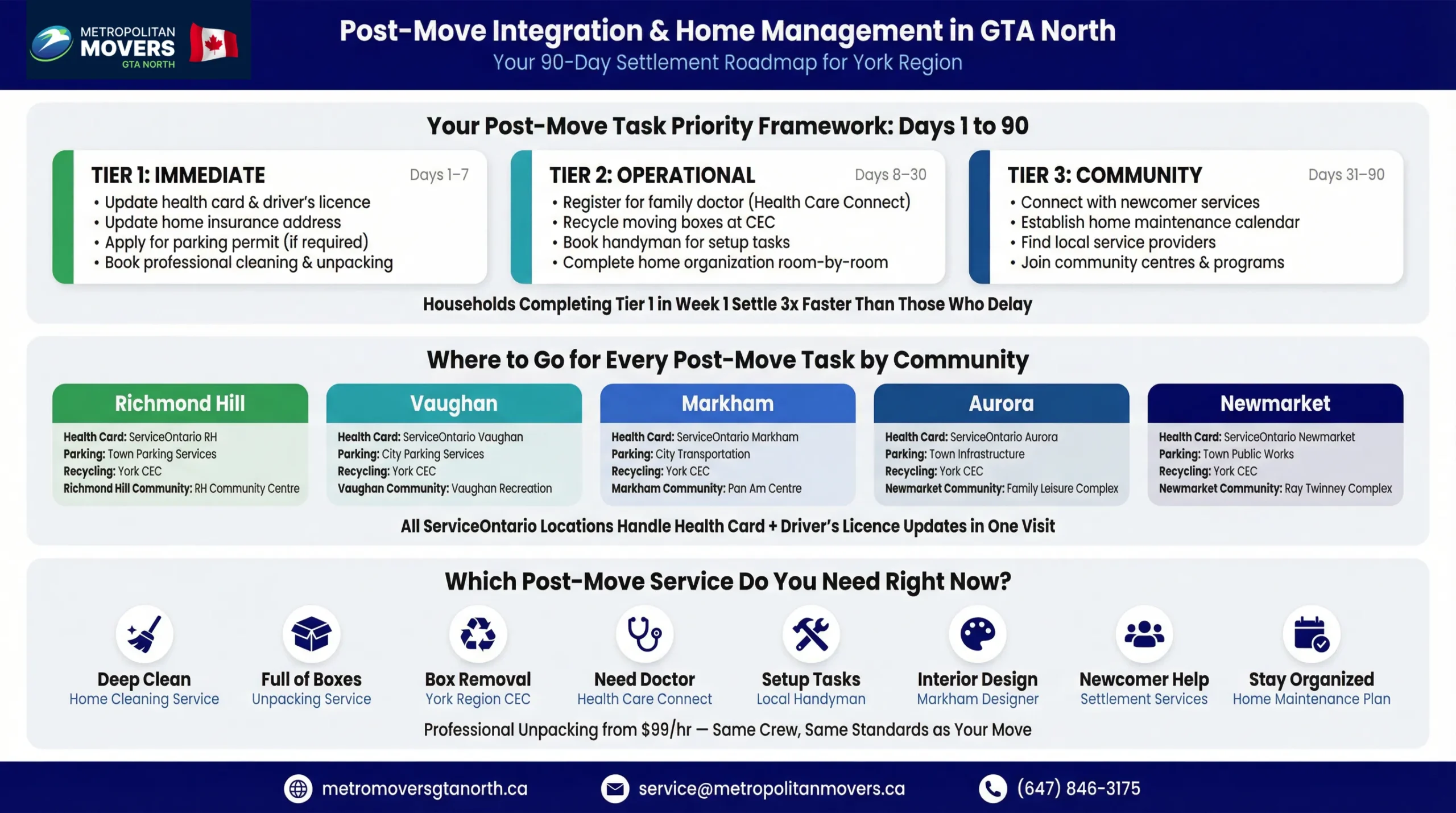
The framework that resolves the post-move period efficiently organizes every task into three priority tiers:
Tier One — Immediate (Days 1 through 7): These are the tasks with financial, legal, or health consequences if delayed. Health card update applications, Ontario driver’s licence address changes, home insurance policy address corrections, and utility account activations all sit in this tier. None of these tasks take long to complete, but all of them carry compounding risk the longer they are postponed.
Tier Two — Operational (Days 8 through 30): These are the tasks that make daily life function normally in the new property — scheduling professional cleaning, arranging box recycling and donation pickup, obtaining a residential parking permit if required, finding a family doctor, connecting with local service providers, and completing home organization in every room. Completing this tier within the first month transforms a property full of boxes into a home.
Tier Three — Community Integration (Days 31 through 90): These are the tasks that connect you and your family to the social, recreational, and community infrastructure of your new GTA North community — school registrations if not completed before move-in, community centre memberships, newcomer settlement services where applicable, and the relationships with local service providers — handymen, cleaners, interior designers — that make ongoing home management reliable and stress-free.
Professional Unpacking Services for Busy Professionals and Families: The Fastest Path to a Functional Home
The gap between “moved in” and “settled” is almost entirely determined by how long the unpacking phase takes. For busy professionals managing a full work schedule from the day after a move, families with young children who need routines restored immediately, and senior residents who cannot sustain the physical demand of multi-day unpacking, professional unpacking services deliver measurable value that extends well beyond convenience.
What Professional Unpacking Includes: A professional unpacking team arrives with the tools, organization frameworks, and physical capacity to unpack every room systematically. Every box is opened, items are placed in their designated locations, packing materials are collected and removed, and each room is functional before the team leaves. The difference between professional unpacking and DIY unpacking is not just speed — it is the end state. A professional unpacking service leaves you with a home you can live in from the evening of moving day. DIY unpacking typically produces a partially unpacked home that stays partially unpacked for weeks.
Room-by-Room Unpacking Priority Sequence: The unpacking sequence matters operationally. Professional teams follow a priority hierarchy: kitchen first (because it affects every meal from the first night), bedrooms second (because sleep quality affects everything else), bathrooms third, living areas fourth, and storage and garage spaces last. This sequence ensures the highest-use spaces become functional first and creates immediate quality of life improvement in the first 24 hours of occupancy.
Kitchen Unpacking: The Highest-Complexity Room: The kitchen requires the most methodical unpacking approach of any room in the home. Every item needs a logical, accessible location — not just a shelf. A professional unpacking team organizes kitchen contents by frequency of use, proximity to the relevant cooking or prep zone, and compatibility with the storage dimensions of the new kitchen layout. A well-organized kitchen from day one saves hours of relocation and reorganization over the following months.
Bedroom Setup for Immediate Sleep Quality: Bed assembly, linen placement, and wardrobe organization are the three unpacking tasks that most directly affect wellbeing on the first night in a new home. A professional team completes all three before leaving, ensuring that every family member sleeps in a functional bedroom — not a room full of boxes with a mattress on the floor.
For GTA North clients who want the complete unpacking and home setup service, packing and unpacking service covers the full unpacking lifecycle from box opening through room organization and packing material removal across all York Region communities.
Home Cleaning After a Move: What the New Property Needs Before You Settle In
Whether you moved into a brand-new property, a recently vacated resale home, or a rental unit whose previous occupants just departed, a professional post-move clean is not optional — it is the foundational step that makes the space genuinely yours.
What a Post-Move Clean Addresses That a Standard Clean Does Not: Move-out and move-in cleaning covers surfaces, spaces, and systems that routine weekly cleaning never reaches: inside kitchen cabinets before your dishes go in, inside refrigerator compartments, oven interiors, window tracks that have accumulated years of dust and debris, bathroom grout and caulking lines, baseboards throughout the entire property, light fixture interiors, and ventilation covers. In a newly vacated home, every one of these areas carries residue from the previous occupants that a surface wipe-down does not address.
Best Home Cleaning Services in Richmond Hill — What to Look For: Richmond Hill’s residential cleaning market includes both established multi-employee companies and individual operators. The criteria that differentiate a reliable cleaning service from a risk are consistent regardless of provider type:
- Insurance and liability coverage: A cleaning company operating in a client’s home must carry general liability insurance. Request the policy number and confirm coverage is active before booking.
- WSIB clearance: Any cleaning company that employs workers — not a solo operator — must carry WSIB coverage. Verify independently before the first clean.
- Detailed service scope in writing: A legitimate cleaning company provides a written scope of work before the appointment — specifying which rooms, which surfaces, and which deep-clean tasks are included at the quoted price. Verbal scopes create dispute exposure.
- Consistent team assignment: Rotating different cleaners through your home at each appointment resets the familiarity curve every time. A company that assigns consistent teams delivers better results and stronger security accountability.
Post-Move Cleaning Sequence for Maximum Efficiency: Schedule your professional clean before the unpacking begins — not after. Cleaning an empty or mostly empty room takes a fraction of the time and effort of cleaning around unpacked furniture and organized shelves. Book the cleaning crew for the morning of or the day before your unpacking service, and let both professional services execute in the optimal sequence.
Where to Recycle Moving Boxes in York Region: A Community-by-Community Resource Guide
A completed GTA North move generates a significant volume of cardboard boxes, packing paper, foam wrap, and stretch film. Managing this material responsibly — through recycling, donation, and proper disposal — is both an environmental obligation and a practical home management task. Boxes and packing material left unaddressed add to the post-move chaos and consume space in every room.
York Region Blue Box Program — Cardboard Recycling: York Region’s residential recycling program accepts flattened corrugated cardboard through the standard blue box collection. The key requirement is that all cardboard must be flattened and broken down before collection — whole assembled boxes are not accepted at kerbside. For large volumes of post-move cardboard, the standard blue box capacity is almost always insufficient for a single collection. The correct approach is to stagger box flattening and collection over two to three pickup cycles, or take excess cardboard directly to the nearest York Region Community Environmental Centre.
York Region Community Environmental Centres: York Region operates Community Environmental Centres (CECs) in multiple locations across the region, accepting cardboard, paper, and a wide range of other recyclable materials directly from residents. CEC locations serving GTA North communities include facilities in Newmarket, Richmond Hill, Vaughan, and Markham. Hours and accepted materials are listed at York Region Waste Management. Dropping off a full load of flattened move boxes at a CEC resolves the entire cardboard volume in a single trip.
Donating Usable Moving Boxes: Clean, structurally sound moving boxes retain value for other families currently planning relocations. York Region residents actively seeking moving boxes post frequent requests through community Facebook groups, Nextdoor neighbourhood apps, and the Buy Nothing network. Posting your available boxes in the local community group for your specific GTA North neighbourhood — whether in Aurora, Vaughan, or Newmarket — typically results in same-day pickup requests. Donating boxes instead of recycling them extends their useful life and eliminates the recycling logistics entirely.
Stretch Film and Foam Wrap — What Cannot Go in the Blue Box: Plastic stretch film and foam wrap are not accepted in York Region’s residential blue box program. Stretch film must be dropped off at participating retail locations that accept soft plastic film for recycling — many major grocery and hardware retailers in GTA North participate in the Canadian Stewardship Services Alliance soft plastic take-back program. Foam wrap goes in the garbage — expanded polystyrene (EPS) foam is not accepted in York Region’s residential recycling stream. Separating your post-move materials by type before disposal ensures nothing ends up contaminating a recycling stream.
Getting a Residential Parking Permit in Vaughan: The Complete Application Process
Vaughan’s residential parking permit system addresses one of the most common post-move friction points in GTA North’s denser residential communities — overnight and long-term street parking in areas where permit requirements apply. Moving into a new Vaughan address without understanding the local parking permit structure creates immediate day-one issues for households with multiple vehicles or for guests requiring regular overnight parking.
Who Needs a Residential Parking Permit in Vaughan: Not every Vaughan street requires a residential parking permit, but many of the city’s higher-density subdivisions, townhouse corridors, and older residential neighbourhoods enforce permit parking bylaws that restrict overnight on-street parking to permit holders. The most common scenarios where a new Vaughan resident needs to apply immediately: properties with a single-car garage that cannot accommodate multiple household vehicles, townhouse developments where visitor parking is limited, and properties with laneway or limited driveway access.
How to Apply for a Vaughan Residential Parking Permit: Residential parking permit applications in Vaughan are processed through the City of Vaughan’s Municipal Parking Services. Applications can be submitted online through the City of Vaughan’s official portal or in person at Vaughan City Hall. Required documentation typically includes: proof of Vaughan residency at the permit address (a utility bill, lease agreement, or property tax statement), the vehicle’s Ontario licence plate number, and valid vehicle registration showing the permit address.
Temporary Visitor Parking Permits: In addition to resident permits, Vaughan offers temporary visitor parking permits that allow overnight street parking for guests. These are particularly relevant in the first weeks of settling into a new property — when family members and friends visiting to help with unpacking and setup require parking beyond the standard visitor window. Temporary permits are issued for defined short-term periods and are available through the same Municipal Parking Services channel.
Parking Permit Lead Time: Submit your parking permit application within the first week of taking possession of your new Vaughan address. Processing times vary but typically run three to five business days. Applying on possession day gives you permit coverage within the first week of occupancy.
Updating Your Ontario Health Card After Moving: The Exact Process for York Region Residents
Updating your Ontario health card address is a statutory requirement — not an optional administrative task — following any change of residential address within the province. An OHIP record that does not reflect your current address creates complications for benefit administration and, in certain circumstances, affects the processing of claims and correspondence from the Ministry of Health.
How to Update Your Ontario Health Card Address: Address updates for Ontario health cards are processed through ServiceOntario. The update can be completed through three channels: in person at any ServiceOntario location in York Region, online through the ServiceOntario self-service portal for eligible cardholders, or by mail using the change-of-address form available from ServiceOntario. You will need your current health card number and your new residential address. The update does not require a new card issuance unless your current card is expired or damaged.
ServiceOntario Locations Serving GTA North: ServiceOntario operates multiple locations across York Region, with offices in Richmond Hill, Vaughan, Markham, Aurora, and Newmarket. Current hours and address details for all York Region locations are available at ServiceOntario. Post-move demand at ServiceOntario locations spikes at month-end dates — visiting mid-week during the middle of the month produces the shortest wait times.
Driver’s Licence Address Update — The Same Visit: Your Ontario driver’s licence address update and your health card address update can both be completed in a single ServiceOntario visit. The Ontario Highway Traffic Act requires a driver’s licence address update within six days of a residential address change. Completing both updates in the same ServiceOntario appointment eliminates a return visit and ensures both documents reflect your new GTA North address simultaneously.
What Else Requires Address Update Through Ontario Government Channels: Beyond the health card and driver’s licence, the following Ontario government registrations require a post-move address update:
- Vehicle registration (updated through ServiceOntario simultaneously with driver’s licence)
- Ontario Disability Support Program correspondence address if applicable
- Ontario Works file address if applicable
- OSAP records for post-secondary students or families with current borrowers
Finding a Family Doctor in Aurora and Across York Region: The GTA North Healthcare Access System
Access to a family physician is one of the most consequential post-move integration tasks for any GTA North household — and one of the most time-sensitive. Ontario operates under a physician shortage that is particularly pronounced in York Region’s growing communities of Aurora, Newmarket, and parts of Richmond Hill. Families who delay this search frequently discover that the process takes considerably longer than anticipated.
The Ontario Health Care Connect Program: The Ontario government operates the Health Care Connect program specifically to match unattached patients — those without a family doctor — with physicians and nurse practitioners accepting new patients in their area. Registration is free and available through Health Care Connect. After registration, a Care Connector contacts you to identify available providers in or near your new GTA North community. The program does not guarantee immediate placement, but registered patients receive priority notification when new capacity opens in the requested area.
Community Health Centres in York Region: York Region operates community health centres that provide primary care services to residents regardless of family physician attachment status. These centres use an interprofessional care model — teams of nurses, nurse practitioners, social workers, and physicians delivering coordinated care. Wait times for community health centre services are generally shorter than for individual physician practices, and services are available to all York Region residents including newcomers to Canada who may not yet hold a provincial health card.
Walk-In Clinics as Bridge Coverage: While the family doctor search progresses, walk-in clinics across York Region provide primary care access for non-emergency conditions, prescription renewals, and routine health matters that cannot wait for a family physician. Walk-in clinics in Aurora, Newmarket, Richmond Hill, Vaughan, and Markham maintain varying hours and accept patients with valid OHIP cards. Identify the nearest walk-in clinic to your new address within the first week of occupancy — you want this information before you need it, not on the day a health issue arises.
What to Bring When Registering with a New Healthcare Provider: When you successfully connect with a new family physician in GTA North, bring: your updated Ontario health card, a complete list of current medications including dosages, a summary of relevant medical history and diagnoses, records of any recent specialist consultations, and the contact information of your previous family physician so the new provider can request records transfer.
Post-Move Home Organization: Turning a Moved-In Property into a Functioning Home
The gap between a house full of correctly placed boxes and a genuinely organized, functional home is the most underestimated dimension of post-move integration and home management. Most households complete the unpacking phase and then live for months in a state of functional-but-not-optimal organization — items in approximately the right rooms but not in the right places, systems not established, storage not optimized.
The Declutter-Before-Organize Principle: The most important home organization rule for a newly moved-in GTA North property is this: do not organize what you should not have moved. Every move is an opportunity to eliminate items that accumulated through years of household inertia — things kept not because they are used but because disposing of them required a decision. Before establishing organizational systems in your new home, conduct a category-by-category review of what arrived in the move versus what actually belongs in your new life. Items that do not make this cut should leave the property before organization begins, not after.
Closet and Storage Organization as the Foundation: In GTA North’s newer residential builds — particularly the townhouse and detached home developments in Vaughan, Aurora, and Newmarket — storage design is often optimized for appearance rather than functional capacity. Before accepting the builder’s standard closet configurations as permanent, assess each closet against your actual storage requirements. Adding a second hanging rod, installing a modular shelving system, or replacing a standard shelf with a custom organizer doubles or triples effective closet capacity and directly reduces clutter in living areas.
Kitchen Organization Systems That Last: Kitchen organization fails when it is designed for the move-in inventory rather than ongoing household flow. The most durable kitchen organization systems account for: how frequently each item is used (daily-use items at eye level and within arm’s reach; rarely-used items in upper or lower cabinets), how items are used together (baking supplies grouped together, not separated across three different cabinets), and how the space will be restocked (pantry items organized so new stock loads behind existing stock — first in, first out).
Home Office Setup for Remote Working Professionals: GTA North’s professional population has a significant remote and hybrid working component. A functional home office is not a luxury in this context — it is a productivity infrastructure decision. The post-move home office setup should prioritize: dedicated ergonomic furniture (a proper desk and adjustable chair, not a kitchen table), cable management from day one (running cables through walls or along baseboards rather than creating a floor hazard), and acoustic treatment in rooms that share walls with high-traffic household areas.
Garage and Utility Space Organization: The garage and utility spaces are the areas where post-move organization most commonly stalls. Items that have no clear room placement end up in the garage by default, creating a permanent overflow zone that never gets addressed. Allocate garage storage zones before the first box enters — sporting equipment, seasonal items, gardening tools, and household consumables each get a defined zone, and items that do not belong in any zone do not belong in the garage.
Best Local Handymen in Newmarket and York Region: What to Look for When Hiring Post-Move
The first weeks in a new GTA North property almost always reveal a list of small maintenance tasks, repairs, and installation jobs that need a skilled tradesperson: picture hanging at the right height and wall anchor rating, television wall mounting with proper stud location, curtain rod installation, minor drywall repairs from the move, cabinet hardware adjustments, and the inevitable list of items the previous owners left incompletely addressed.
What Qualifies a Reliable Local Handyman in GTA North: The handyman market in York Region spans a wide quality and reliability range. The criteria that identify a dependable operator:
- Liability insurance: Any handyman performing work in your home should carry minimum $2 million general liability coverage. Request the certificate of insurance before booking.
- Clear written scope and price: A reliable handyman provides a written itemized quote for all tasks before starting any work. Verbal quotes on a per-hour basis without scope clarity create cost disputes.
- References from GTA North clients: A handyman actively working in Newmarket, Aurora, or Richmond Hill should be able to provide references from clients in those specific communities — not just a generic testimonial page.
- Licensed versus unlicensed trades: Handymen can legally perform a wide range of maintenance and repair tasks in Ontario, but electrical, plumbing, and HVAC work requires licensed tradespeople. A handyman who offers to perform these services without the appropriate trade licence creates both safety risk and home insurance coverage risk for the property owner.
Typical Post-Move Handyman Task List for GTA North Homes: The most common post-move handyman requests from GTA North residents in the first 30 days include:
- Television and monitor wall mounting
- Picture and art hanging with appropriate wall anchors
- Curtain rod and blind installation
- Smart doorbell and thermostat installation
- Cabinet door and drawer adjustment and alignment
- Minor drywall patching and touch-up painting
- Weatherstripping replacement on exterior doors
- Smoke and carbon monoxide detector installation and testing
Best Interior Designers in Markham: Making Your New GTA North Property Reflect Your Vision
A new GTA North property — whether a Markham townhouse, a Richmond Hill detached home, or a Vaughan condo — is a blank canvas at the point of move-in. Many residents defer interior design decisions under the pressure of settling in, living with builder-standard finishes and furniture placement that was decided by logistics rather than aesthetics. Engaging a local interior designer in the post-move phase transforms that canvas into a space that functions beautifully and reflects the household’s specific lifestyle.
What a Markham Interior Designer Delivers for Post-Move Clients: An interior designer working with a newly settled GTA North household addresses both aesthetic and functional dimensions of the space: furniture placement that optimizes traffic flow and natural light, colour selection that works with the property’s fixed finishes, storage solutions that eliminate the visual clutter of incomplete organization, and material and textile selections that create cohesion across rooms that arrived furnished from different previous homes or purchased from multiple retailers at different times.
Interior Design Consultations vs. Full-Service Design: Most GTA North interior designers offer multiple service levels. An hourly consultation — typically two to four hours spent walking through the property — delivers specific, actionable recommendations that the homeowner then implements independently. Full-service design involves the designer managing specification, procurement, and installation of all design elements. For most post-move clients, a single consultation with a written recommendation summary is sufficient to resolve the most significant design decisions and provide a roadmap for the rest.
What to Prepare Before Your Interior Design Consultation:
- Photographs of all existing furniture and rugs that will remain in the space
- The dimensions of every room requiring design attention
- A clear brief: what is working in the current layout, what is not, what the household’s primary use of each space is
- A realistic budget ceiling for any purchases or installations the designer may recommend
- Reference images of spaces you find appealing — designers work more efficiently when they understand a client’s aesthetic instincts rather than starting from a blank preference sheet
Newcomer Community Resources in York Region: Building Your Network in GTA North
York Region is one of the most demographically diverse communities in Canada, with a significant and continuously growing newcomer population across all of its municipalities. For families and individuals relocating to GTA North from outside Canada, the post-move integration phase extends beyond home management to encompass language settlement, employment navigation, social connection, and access to culturally relevant services.
York Region Newcomer Settlement Services: York Region’s Human Services department coordinates and funds settlement services across the region through partnerships with community agencies. Services available to newcomers in GTA North include: English language training programs (LINC — Language Instruction for Newcomers to Canada), employment preparation and job search support, credential recognition assistance for internationally trained professionals, and social integration programs specifically designed for newcomer families. York Region’s newcomer resource directory is maintained at York Region Community and Health Services.
Community Centres with Newcomer Programming in GTA North:
Richmond Hill — Richmond Hill Centre for the Performing Arts and Community Facilities: Richmond Hill’s community infrastructure includes recreation centres in multiple neighbourhoods that host newcomer orientation programs, multicultural events, and language exchange circles. The town’s high-density demographic diversity makes Richmond Hill one of the most actively programmed communities in York Region for newcomer integration.
Markham — Markham Civic Centre and Recreation Facilities: Markham operates a network of recreation centres across its distinct communities — Unionville, Cornell, Milliken Mills, Berczy Village — each with programming tailored to its local population. The City of Markham’s Recreation and Culture department maintains active newcomer programming through its community centres, with particular depth in Mandarin, Cantonese, and South Asian community programming given the city’s demographic composition.
Aurora — Aurora Family Leisure Complex: Aurora’s community centre and recreation complex offers programming for newcomer families, with connections to the broader York Region settlement service network for residents new to the town.
Newmarket — Newmarket Community Centre and Ray Twinney Recreation Complex: Newmarket’s recreation and community facilities serve a growing newcomer population in the town’s newer residential developments. The town’s community programming includes settlement navigation assistance through the Southlake Regional Health Centre’s community programs in addition to municipal recreation services.
Vaughan — Vaughan City Hall Newcomer Services: The City of Vaughan operates dedicated newcomer services through its Recreation and Culture department, with programming available in multiple languages and connections to the region-wide York Region Social Services network.
Finding Your Cultural Community Network in GTA North: York Region’s newcomer population includes substantial community organizations across dozens of cultural communities. South Asian, East Asian, Middle Eastern, Latin American, West African, and Eastern European community associations all operate actively across the region, organizing cultural events, business networks, religious gatherings, and social support structures that accelerate post-move integration in ways that government settlement services alone cannot replicate. Connecting with your specific cultural community organization within the first 30 days of moving to GTA North provides both social connection and practical local knowledge that no directory can fully substitute.
Managing the Home in the Months After Moving: Building Systems That Prevent Post-Move Drift
Post-move integration and home management does not conclude at the 90-day mark. The households that successfully transition from “recently moved” to “fully settled” do so because they establish ongoing home management systems in the first few months — not because they work harder, but because they work with systems that require less reactive effort.
Home Maintenance Calendar for GTA North’s Climate: York Region’s climate imposes a seasonal maintenance rhythm on every property. Establishing a home maintenance calendar in the first weeks of occupancy — before the first maintenance task becomes urgent — prevents the expensive reactive repairs that result from deferred maintenance.
Spring (March to May):
- Inspect roof and eavestroughs for winter ice damage — particularly on properties with flat or low-slope roof sections
- Service the air conditioning system before first use of the cooling season
- Check exterior caulking and weatherstripping around all windows and doors after thermal cycling through a GTA North winter
- Flush sediment from the hot water tank if it has not been done in the past 12 months
- Inspect the driveway and walkways for frost heave damage and address cracks before spring water infiltration widens them
Summer (June to August):
- Clean dryer vent duct annually — a blocked dryer vent is one of the leading causes of residential fires in Ontario
- Inspect window and door screens
- Check attic ventilation — adequate summer attic ventilation directly affects cooling costs and shingle lifespan
- Test all smoke and carbon monoxide detectors and replace batteries
Fall (September to November):
- Service the furnace and replace the filter before the heating season begins
- Clean eavestroughs after leaf fall is complete
- Disconnect and drain exterior garden hoses before the first freeze
- Check weatherstripping on all exterior doors before the heating season — a visible gap under an exterior door loses significant heat volume over a York Region winter
- Have the chimney inspected if the property has a wood-burning fireplace
Winter (December to February):
- Check attic insulation adequacy — inadequate attic insulation creates ice dam formation on the roof overhang that causes eavestrough and soffit damage
- Keep exterior walkways and steps clear of ice and snow — as a property owner, you carry liability for falls on your walkway
- Monitor for condensation on windows in extreme cold — persistent condensation indicates humidity management or window seal issues
The Connection Between a Well-Executed Move and a Smooth Post-Move Settlement
The quality of your post-move integration and home management experience is significantly shaped by the quality of the move itself. Households that arrive at a new property with every box correctly labelled, every piece of furniture placed in the right room on move day, and every specialty item undamaged enter the post-move phase with a clean operational slate. Households that arrive at a property in disorder — mislabelled boxes mixed across rooms, furniture placed randomly by an exhausted crew, items damaged during transport — begin the post-move phase already behind, spending the first week recovering from the move rather than building toward settlement.
This is precisely the reason that Metropolitan Movers GTA North treats the move-day execution as the foundation of the post-move experience — not just as a job that ends when the truck leaves. With 15+ years of York Region relocations behind the team’s operational framework, the connection between a controlled, well-planned move and a smooth, fast post-move settlement is something the team understands from direct experience across thousands of GTA North households.
The packing and unpacking service extends that commitment directly into the post-move phase — professional unpacking, room-by-room organization, and packing material removal that hands you a functional home on moving day rather than a property full of work to do. For clients who need storage integration during the settlement period, storage and moving services provide a flexible bridge between move-in day and full occupancy readiness.
For senior clients settling into a new GTA North community, the senior moving service includes post-move setup support — furniture placement for functional accessibility, essential room setup before the crew departs, and coordination with family members managing the settlement process from outside the immediate area.
For the complete picture of available services supporting every stage of your GTA North relocation — from the first box packed through the last room organized — visit the services overview or reach the team directly through the contact page.
| Post-Move Task | Priority Tier | Recommended Timeline | GTA North Resource / Channel |
|---|---|---|---|
| Update Ontario health card address | Immediate | Within first 7 days | ServiceOntario — Richmond Hill, Vaughan, Markham, Aurora, Newmarket locations |
| Update Ontario driver’s licence address | Immediate | Within 6 days (statutory requirement) | ServiceOntario — same visit as health card update |
| Update home insurance policy address | Immediate | Move day or day after | Your insurance broker directly |
| Apply for residential parking permit | Immediate | Within first week | City of Vaughan / Richmond Hill / Markham Municipal Parking Services |
| Book professional home cleaning | Operational | Before or day of unpacking | Local insured cleaning service — request written scope |
| Schedule professional unpacking service | Operational | Moving day or day after | metromoversgtanorth.ca/packing-and-unpacking-service |
| Recycle moving boxes and packing materials | Operational | Within first 2 weeks | York Region CEC or kerbside blue box (flattened only) |
| Register with Health Care Connect for family doctor | Operational | Within first 30 days | ontario.ca/page/find-family-doctor-or-nurse-practitioner |
| Book local handyman for post-move task list | Operational | Within first 30 days | Local insured operator — request written quote |
| Connect with newcomer settlement services | Community Integration | Within first 30–60 days | york.ca/wps/portal/yorkhome/health/yr/newcomers |
| Establish seasonal home maintenance calendar | Community Integration | Within first 60–90 days | Local licensed contractors for HVAC, roofing, electrical |
| Post-move integration master checklist for GTA North residents | metromoversgtanorth.ca | |||
| GTA North Community | Parking Permit Authority | Box Recycling Facility | ServiceOntario Access | Primary Community Centre |
|---|---|---|---|---|
| Richmond Hill | Town of Richmond Hill Parking Services | York Region CEC — Richmond Hill | ServiceOntario — Richmond Hill location | Richmond Hill Community Centre |
| Vaughan | City of Vaughan Municipal Parking Services | York Region CEC — Vaughan | ServiceOntario — Vaughan location | Vaughan Recreation Centres (multiple) |
| Markham | City of Markham Transportation and Infrastructure | York Region CEC — Markham | ServiceOntario — Markham location | Markham Pan Am Centre / Cornell Community Centre |
| Aurora | Town of Aurora Infrastructure and Environmental Services | York Region CEC — Newmarket (nearest) | ServiceOntario — Aurora / Newmarket location | Aurora Family Leisure Complex |
| Newmarket | Town of Newmarket Public Works and Infrastructure | York Region CEC — Newmarket | ServiceOntario — Newmarket location | Ray Twinney Recreation Complex |
| GTA North community resource reference | Verify current hours and availability with each authority directly | metromoversgtanorth.ca | ||||
Frequently Asked Questions — Post-Move Integration & Home Management in GTA North
How long does post-move integration realistically take for a GTA North household?
The honest answer depends on how proactively the process is managed. Households that schedule professional unpacking, book cleaning in advance, and complete administrative tasks within the first week typically feel genuinely settled within three to four weeks. Households that unpack gradually on their own, delay administrative tasks, and address service connections reactively frequently live in a state of partial settlement for two to three months. The 90-day framework outlined in this guide — with immediate, operational, and community integration tiers — is designed to compress the settlement timeline for busy GTA North families and professionals regardless of move complexity.
Is professional unpacking worth the cost for a standard GTA North household move?
For households where daily life resumes immediately after a move — professional work schedules, children in school, caregiving responsibilities — professional unpacking is not a luxury. It is a time and wellbeing investment that delivers measurable returns. The cost of a professional unpacking service is typically a fraction of the total moving cost, and the outcome — a functional, organized home on moving day rather than weeks of evening and weekend unpacking — directly affects the quality of the first weeks in your new property. The packing and unpacking service team handles the complete unpacking lifecycle for GTA North clients across all community types.
What is the fastest way to find a family doctor in Aurora or Newmarket after moving?
Register with Ontario’s Health Care Connect program immediately after establishing your new GTA North address. The program matches unattached patients with physicians and nurse practitioners accepting new patients in the requested area and provides priority notification when capacity opens near your address. While waiting for a Health Care Connect match, identify the nearest walk-in clinic to your new address and locate your nearest York Region community health centre for non-emergency primary care access. These bridge options ensure you are not without healthcare access during the physician search period.
How do I recycle moving boxes in York Region if my kerbside bin is too small to fit all of them?
Flatten all cardboard boxes completely before kerbside placement — this is a firm requirement, not a suggestion, for York Region’s residential recycling program. For post-move cardboard volumes that exceed multiple kerbside collection cycles, take the excess directly to your nearest York Region Community Environmental Centre, which accepts flattened cardboard drop-offs from residents without appointment. Posting available clean boxes in your local community Facebook group or Nextdoor page is also a fast and effective disposal method — move-size cardboard boxes are consistently in demand and typically get claimed within hours of posting.
Do I need a residential parking permit immediately after moving to Vaughan?
Not every Vaughan address requires a residential parking permit — permit requirements apply to specific streets and zones designated under Vaughan’s parking bylaw. Check your specific street’s permit status through the City of Vaughan’s online parking portal or by calling Municipal Parking Services before assuming a permit is required. If your street is permit-required, apply within the first week of taking possession to avoid any overnight parking enforcement exposure. The application process requires proof of Vaughan residency, your licence plate number, and valid vehicle registration.
What should I clean first in a new GTA North home before unpacking begins?
The correct cleaning sequence before unpacking is: kitchen cabinets and drawers first (since these receive food contact items immediately), bathroom surfaces and fixtures second, all window sills and tracks third, baseboards and floor surfaces in every room fourth, and light fixtures and ventilation covers last. Completing this sequence before the first box is unpacked ensures every surface that will hold your belongings is clean before those belongings arrive. Scheduling a professional cleaning service for the morning of or the day before your unpacking service is the most time-efficient approach to this sequence.
What home maintenance tasks should I complete in the first 90 days of moving into a GTA North property?
The three most consequential first-90-day home maintenance actions for any GTA North property are: servicing the furnace and replacing the filter before the heating season if you move in between August and November; testing all smoke and carbon monoxide detectors and replacing batteries regardless of move date; and inspecting exterior caulking and weatherstripping on all windows and doors to assess thermal efficiency before your first full heating season. These three tasks have the highest direct impact on safety and operating costs in the first year of ownership or tenancy and can all be completed within the first month at a modest combined cost.
How do I connect with newcomer community services in York Region after moving to GTA North?
York Region’s newcomer settlement services are coordinated through York Region Community and Health Services at york.ca and delivered through a network of community agency partners across all five GTA North municipalities. The first contact point is the York Region 211 helpline — available by phone, text, and online — which connects callers with the specific settlement services, language programs, employment support, and community resources relevant to their specific situation and community. In parallel, connecting with cultural community associations specific to your background provides social integration and practical local knowledge that government settlement services complement but cannot fully replace.
How do I find reliable local handymen and tradespeople in Newmarket and GTA North after a move?
The most reliable sourcing channel for local tradespeople in GTA North’s communities is direct referral from established residents in your specific neighbourhood — ask neighbours, connect through local community Facebook groups specific to your street or subdivision, or use the Nextdoor platform to request recommendations from verified neighbours. For licensed trade work — electrical, plumbing, HVAC — verify contractor licensing through the Ontario College of Trades before booking, and always request WSIB clearance and a written scope with price before any work begins. The combination of a verified referral, confirmed licensing, and a written agreement before work starts is the standard that eliminates the majority of post-move contractor disputes in GTA North.
Can I book unpacking services separately from my moving service, or does it need to be combined?
Unpacking services can be booked independently of the move itself — as a standalone post-move service delivered the day after your moving crew completes the physical relocation. This is often the optimal approach: the moving crew focuses entirely on the physical transport and placement execution on moving day, and the unpacking team arrives the following morning with the specific focus and organization framework that unpacking requires. Booking both services with the same operator eliminates coordination friction and ensures the unpacking team is already familiar with how your shipment was packed and labelled. The packing and unpacking service operates as both a standalone service and as part of a full-service moving package across all GTA North communities.